
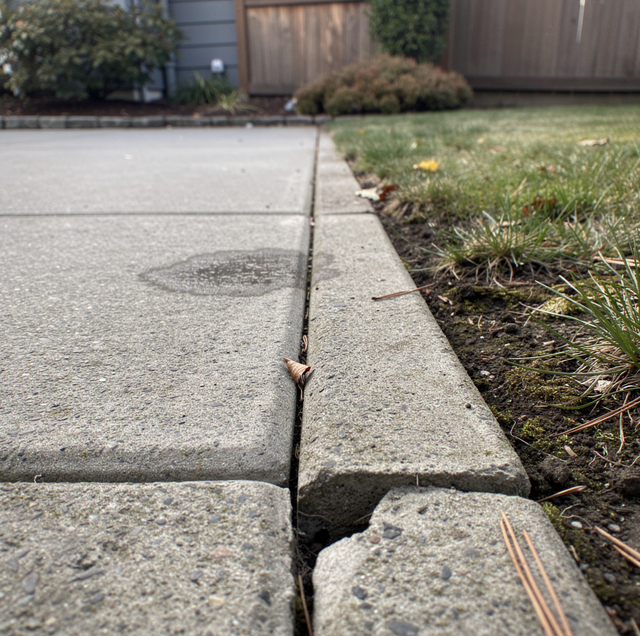
A raised lip at a sidewalk joint is one concrete panel sitting higher than the panel next to it, by an amount small enough to catch with a toe before you would notice it by eye. The fix turns on a question about the panel under that step: is the panel that is out of level sound and done moving, or is something under one side of that joint still pushing up or still dropping away? Grinding, lifting, and replacing a section all solve the same lip, but each one only makes sense for a different answer to that question, and picking the wrong one either wastes the visit or leaves whatever is causing it working underneath a repair that will not hold.
Each fix fits a different reading of the panel itself:
| What's Going On | The Fix That Fits | What It Leaves Behind |
|---|---|---|
| One panel sits higher at the joint, both panels are solid, and the offset has stopped growing | Grinding the high edge | A tapered, textured strip where the material came off; whatever pushed the panel up in the first place is still there |
| The low panel has dropped because the ground under it lost support, and the panels themselves are still intact | Lifting the low panel | The panel raised back toward level once the space beneath it is filled; a panel already broken into pieces is not a candidate |
| The slab is cracked into more than one piece, is still actively heaving or sinking, or has lost so much support that there is nothing solid left to raise | Cutting out and repouring the section | A new panel set at the right height and joints; the sections on either side stay untouched unless they are compromised too |
How Grinding Takes the Edge Down to a Gentle Taper
Grinding reshapes the existing panel in place. A wheel runs across the top of the higher slab, removing material only at the joint and blending it into a shallow, sloped transition. The lower panel is left alone; the cut runs entirely into the panel that is proud of the line. The cutting face is a cup wheel set with diamond segments that wears away the concrete by abrasion, so the edge comes down in thin passes while the rest of the panel stays intact. Because the goal is a grade a foot can roll across, the taper extends back from the joint, which turns a lip that catches a toe into a gradual slope.
A raised lip cut with a handheld angle grinder throws concrete dust carrying crystalline silica, a lung hazard with repeated exposure, and the disc can kick against a raised edge. A crew running vacuum-shrouded equipment handles that cut, with respirators on hand.
When a Sound, Settled Panel Is the Right Candidate
Grinding earns its place when two conditions are met: the panel itself has no structural damage, and whatever caused it to be out of level has stopped working. The offset itself also has to be modest; a step tall enough that a taper would run far back into the panel is a lifting or replacement job. A panel that is still being pushed up by whatever sits underneath it will present the same lip again after the edge is taken down, because grinding changes only the surface and leaves whatever is acting on it from below in place. The same holds in the other direction: a low panel that is still dropping turns a ground-down high edge into a symptom fix, since the height difference returns as the section keeps moving.
When the Low Panel Needs Lifting Instead
A raised lip has two sides, and sometimes the moving panel is the lower one. When a panel has dropped because the ground supporting it gave way, a void, loose fill, or soil that eroded or shrank out from under it, taking material off the high panel's edge does nothing for the void under the low one. The low panel needs the space underneath it filled, and the panel raised back toward the level of its neighbor, work that starts beneath the slab. That is a different repair, using different equipment than grinding, and it only applies while the dropped panel is still a single solid piece.
When the Slab Itself Calls for Replacement
Some panels are past what grinding or lifting can fix. A panel cracked into more than one piece has no single plate left to grind a taper into or lift as a unit. A panel still actively heaving, from a root that keeps thickening under it season after season, has not finished moving, so any grade cut into it now is temporary. And a panel that has lost its base has nothing firm left under it to lift against. In any of these cases, cutting the section free at its joints and pouring a new panel is the fix that holds, because it starts over with sound concrete and a rebuilt base.
What a Ground Edge Looks Like Once the Work Is Done
A taper ground into a panel looks different from the surrounding concrete, and that difference stays visible. The grinding wheel cuts into the surface layer of the slab and exposes the aggregate mixed into the concrete, the small stones bound in the cement paste, which reads as a rougher texture and a different color from the smooth, cured surface around it. On a broom-finished driveway or sidewalk, a ground strip is easy to walk past without noticing unless you are looking for it. The color can even out as the strip weathers and picks up the same dirt and wear as the rest of the panel, but the texture change at that edge is permanent, because grinding removed material rather than adding a coating that could later be redone to match.
Marking and Managing the Trip Hazard Until the Work Is Done
A lip that catches a toe is a hazard from the moment it appears. The catch point is the exposed face of the high panel, which snags a foot moving toward it from the low side; walking the other way, the foot drops down the offset. Marking the spot with tape, chalk, or a cone and steering foot traffic around it costs nothing and works immediately, while a grind or a lift takes time to schedule and complete. Prying a raised panel up or chipping at the edge with a hand tool doesn't correct the offset and adds a real risk of cracking sound concrete or catching a hand under a piece that shifts; the grind, the lift, or the repour is the fix that corrects the offset. Responsibility for a sidewalk's upkeep along a public street varies by location, and the local authority for that stretch decides who maintains it.
Frequently Asked Questions
Yes. A joint that meets its neighbor at an angle, such as where a sidewalk curves around a tree pit or turns at a corner, needs the taper carried along that same path rather than cut in a single straight line, so the ground strip follows the joint's own shape.
Not meaningfully, on a sound panel. A slab resists bending through its overall thickness rather than through the surface layer alone, and the shallow strip removed at a high edge sits close to the surface rather than through the panel's full depth, so a sound panel retains its bending strength throughout its depth.
Fresh damage at the joint is the evidence to look for. A sealant bead that has torn or pulled away from one panel, or a new hairline crack running back from the high edge, can mark recent movement. A joint whose sealant is intact and whose step edge carries the same weathered grime as the panel tops around it shows no sign of recent movement.
Yes, if the joint had a sealant bead running along it. The grinding wheel can pull out or thin the sealant where it crosses that stretch of the joint, leaving a gap that lets water and grit back into the joint. A fresh bead run along the ground section afterward closes that gap again, and it is a small, separate step from the grinding itself.
It can be ground, but the result looks different than it does on plain concrete. A stamped pattern and a color broadcast onto the surface sit in the top layer of the slab, so a grind at the joint cuts through them along the treated strip; a slab colored through its full depth carries that color at the grind, and a stamped one still loses its pattern. On plain gray concrete the ground strip shows as a texture change; on a decorative surface it shows as a break in the pattern, the visible trade-off for keeping the section.
Only at the edge it treats. Grinding levels the step at the joint; it does not regrade the slope of the panel on either side. A section that was already directing water toward or away from that edge before the grind keeps doing the same thing afterward, so a standing-water problem somewhere else on the same panel is a separate issue the grind does not touch.
Enlist concrete grinding and leveling on the raised sidewalk section — a ground taper at the high edge, or poly foam lifting for a panel that has dropped. PTTC Concrete LLC serves Olympia, Tacoma, and Lacey. Call (253) 785-2490.
