
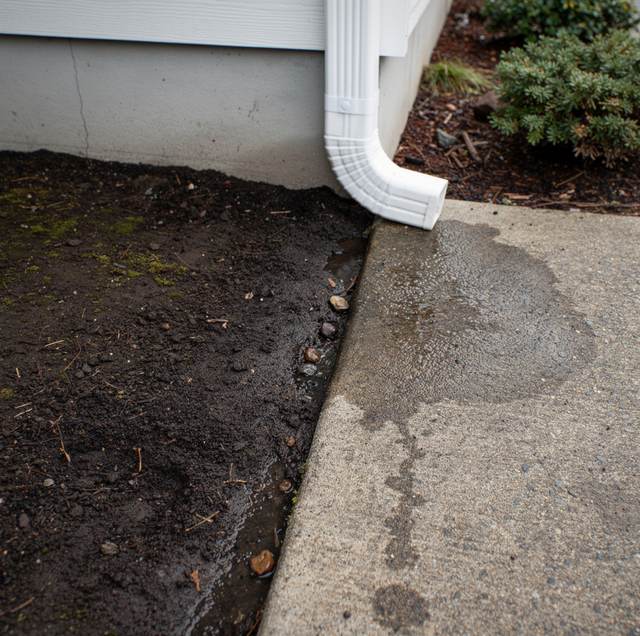
Concrete looks like the one surface on the property water cannot hurt: hard, gray, and poured to shed rain. That look is why water standing along a driveway edge or running under a patio gets ignored until the slab cracks. A slab never works alone, though. It sits on a compacted base and beside soil, and water reaches it through both. Drainage-related damage traces back to a handful of paths water takes to reach a slab from somewhere else on the property.
Downspout and Roof Water Dumped at a Slab Edge
A roof collects rain across its entire surface and funnels that volume down through one or two downspouts, so a downspout emptying right at a slab edge delivers a concentrated flow that the surrounding, unroofed yard never experiences from the same storm. That water lands on the same narrow strip of ground every time it rains, and repeated saturation there does two things: it softens the soil supporting that section of the slab's edge, and the moving water as it passes can carve a channel that undercuts the edge from below. Carrying the downspout past the slab fixes both problems at once. Extending the discharge point several feet beyond the edge, tying it into a buried drain line, or routing it to a splash block angled away from the concrete moves that concentrated volume off the one strip of ground doing the damage.
Ground Graded Toward the Slab
Every yard has a slope, whether anyone planned it or not, and where that slope points decides whether rain runs away from a slab or arrives at it. Ground that sits flat against a slab, or dips toward the concrete, directs runoff from the lawn, planting beds, and neighboring hardscape onto or under the edge rather than past it. That kind of grading problem can develop years after the concrete goes in: mulch piled against an edge, a raised flower bed, or fill dirt added during other yard work can each lift the ground high enough to reverse a slope that once worked correctly. Once water arrives from the side, it moves into the joint, along the underside of the edge, and into the base, regardless of its source. Correcting the grade so the ground drops away from the slab for several feet, and keeping mulch and soil below the level of the slab's edge rather than banked against it, keeps that water moving past the concrete instead of into it.
A Saturated Base Loses Its Support
Under a slab sits the base, a layer built to carry the concrete's own weight and everything placed on top of it without shifting. That base does its job by staying compacted and reasonably dry: soil and the rock above it hold their shape and pass load downward. Water changes that. Under steady rain on soil that holds water, the base has little chance to firm up between storms; under light rain on soil that drains on its own, it does. Where the base compresses or shifts because it never firms up between storms, the slab above it settles unevenly, and a slab that drops or tilts from a softened base is telling the same story as one built on a base that was never compacted properly in the first place.
Fine Soil Washing Out From Under a Slab
Moving water takes support out from under a slab even as it drains through. As water works its way under an edge or through a crack and out the other side, it carries the smallest particles in the soil along with it, the fine silt and clay that fill the gaps between larger grains of the base material. That process, sometimes called piping, starts slowly: a small amount of fine material leaves with each rain event, and the base loses density from within without any sign at the surface.
A washed-out slab can span a hollow while still looking solid. A vehicle or loaded equipment on it can crack it through and drop the section, so keep weight off it until a concrete contractor has checked what is underneath.
Given enough cycles, the loss reaches a point where a gap opens directly under the slab, and the slab is left spanning a gap it was not built to span. Stopping the washout means giving that moving water somewhere else to go, intercepting it before it reaches the base with a drain, or correcting the grade and downspout that fed it, rather than waiting for erosion to reach the surface.
Water Held in the Pores Through Freezing
Every path described so far shares one effect: a drainage problem keeps water from draining away and instead leaves it sitting against or inside a slab, preventing it from drying out between storms. That standing saturation becomes a distinct kind of damage once temperatures drop below freezing: water trapped in concrete's pores expands as it turns to ice and pries the material apart from within. A slab with a downspout dumping at its edge, ground graded toward it, or a base that can't shed water carries that trapped moisture into a freeze; a slab that drains between storms does not carry the same load into the cold. Fixing the water source before winter, rather than after cracking and flaking appear, keeps that stored moisture out of the concrete before it has a chance to freeze.
What to Fix Before Any Repair or New Pour
Patching a crack, resurfacing a flaking driveway, or pouring a brand-new slab over the same ground that damaged the old one addresses the visible half of the problem and leaves the water source in place. Before any of that work starts, the fix that matters sits upstream of the concrete: downspouts carrying roof water past the slab rather than onto it, grading that drops away from the edge rather than toward it, and a base built or corrected so it can shed water rather than hold it. On wet, soft ground, the base beneath a new pour is rebuilt as part of the drainage fix; on firm, well-draining soil, grading and downspouts can be the whole job. A contractor evaluating a damaged slab checks where the water on the property is going before deciding whether resurfacing, a partial replacement, or a full repour is the right call, since concrete poured or patched over an unresolved drainage problem is concrete positioned to fail the same way again.
Frequently Asked Questions
A foam backer rod pressed into the gap with a flexible sealant over it. The rod prevents the sealant from bonding to the base of the joint, so it adheres only to the two vertical faces and can flex there rather than tear loose. That seal prevents runoff from reaching the house side of the slab by dropping straight down the joint into the base, and it is renewed when the sealant cracks or pulls away from either face.
It solves the part right at the slab, but only if where the extension empties gets checked too. An extension that runs a few feet out and then discharges onto ground that still slopes back toward the house just relocates the saturation a short distance rather than removing it, so the discharge point needs its own path away from the structure, not just distance from the edge.
A curtain drain is a gravel-filled trench built around a perforated pipe, set upslope of a paved area to intercept water moving through the soil before it ever reaches a slab's edge. Regrading redirects water moving across the surface; a curtain drain catches water moving underground, which matters a lot where groundwater moves downslope toward the slab from higher ground, including from a neighboring property, in a way that surface grading alone can't redirect.
It changes where the water ends up rather than removing the risk. Permeable concrete is designed to let water pass through the surface into a stone reservoir beneath it rather than running off, so if that underlying reservoir isn't given its own outlet, the water still saturates the ground under the slab, just by a different route than surface runoff.
A dark, damp band that stays wet along the base of a slab edge after the rest of the yard has dried marks a spot where water lingers in the soil rather than draining through it, and that lingering dampness is the detail that points to drainage as the cause rather than the concrete itself.
Yes. A sprinkler head aimed at or spraying onto a slab edge delivers the same kind of concentrated, repeated moisture as a poorly aimed downspout, just on a schedule set by an irrigation timer instead of the weather, so a system running through a dry stretch can keep the ground at a slab's edge saturated on days when nothing fell from the sky.
Worried that water is undermining your concrete? Get your grading and drainage evaluated and corrected before it costs you a slab. PTTC Concrete LLC serves Olympia, Tacoma, and Lacey. Call (253) 785-2490.
