
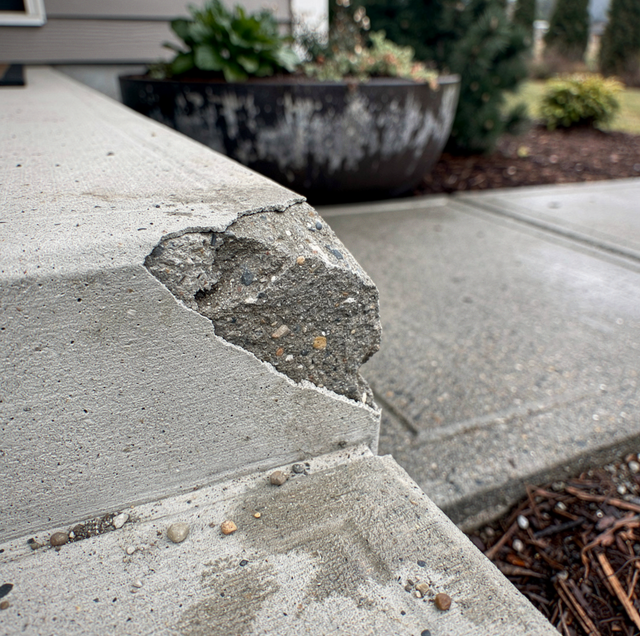
A concrete step corner breaks for reasons built into the shape of the step. Two faces meet there instead of one, the leading edge of the tread carries less concrete mass than a flat slab behind it, and it takes the impact of every hand truck, dolly, toolbox, planter, and dropped object that ever crosses the step. What decides whether that corner gets patched, formed and re-poured, or the step rebuilt is what is still holding the corner up behind the break, and the comparison that follows pairs each kind of break with what sits behind it and the repair that fits.
| What the Break Looks Like | What's Likely Behind It | The Repair That Fits |
|---|---|---|
| A clean chip, with sound, solid concrete on every side of it | The corner broke off, but nothing around it has weakened | A patch with bonded repair mortar |
| The corner sounds hollow when tapped, or keeps crumbling at the edges | The concrete right behind the break has already lost its strength | Cut back to sound concrete, then form and re-pour the corner |
| Rusted, expanding steel is visible in the break | Reinforcing steel has corroded and is pushing the concrete apart as it expands | The corroded steel gets addressed first; a patch or pour over it won't hold |
| The step has tipped, dropped, or pulled away from the house | The step itself has settled or shifted | The step gets releveled or rebuilt |
| Several corners are breaking across the same flight of steps | A weakness shared across the whole run | The flight gets assessed as a whole |
A broken step corner is a trip and fall hazard until it's fixed. Mark the step or route traffic around it, and leave any grinding, forming, or demolition work at the edge to a concrete contractor rather than attempting it yourself.
Why Step Corners Break
A step corner carries two disadvantages a flat section of slab doesn't have. The tread and riser meet at that point, so the corner is thin concrete with two open, unsupported faces instead of one, with less mass to absorb a hit before it chips. That geometry is fixed the day the step is formed.
Impact does the rest. A dropped tool, a hand truck wheel catching the edge, or furniture dragged up the step lands force on the thinnest, least supported part of the whole step. A flat section of the same slab spreads that force out through the surrounding concrete; a corner has nowhere for the force to go but out, which is why it chips instead of just marking.
Reinforcing steel plays a part when it's set too close to the surface at the corner. Steel needs a layer of solid concrete over it to do its job and stay protected. Where the cover is thin right at the edge, there's less concrete holding the corner together, and the corner gives way with less force than a section with fuller cover would require.
Reading What's Behind the Break
The chip itself only tells part of the story. What matters is the condition of the concrete behind and around it, read with a few simple checks before any repair gets picked.
Tap the area around the break with a screwdriver handle or another small, hard object. Solid, sound concrete answers back with a short, dull knock. A hollow or drum-like sound can mean the concrete behind the chip has separated, or that a void lies beneath the step, and either way, a patch applied over that section has nothing solid to bond to.
Look at the color and texture of what's exposed in the break. Gray, dense concrete with clean fracture lines is sound. Concrete that crumbles at a touch, or that looks chalky and soft where it broke, has already lost strength in that spot, and cutting back to where it turns solid again is part of any repair that's going to hold.
Rust showing in the break means the steel is corroding, and a patch over it only hides damage that keeps spreading.
A piece that's still intact and in hand can look like an easy fix: set it back in place and bond it with an adhesive. On a step, that isn't a repair that holds. The break line stays a weak point: a glued piece rides on a single adhesive line at the edge that takes every impact, and fractured faces that do not mate cleanly leave it free to loosen again at the same seam.
Why a Thin Patch on an Edge Fails
A corner repair is judged by a narrower standard than a flat patch on an open section of slab. An edge hands a patch two problems a flat surface doesn't.
The first is thickness. Patch material smeared over a flat crack can taper down to nothing at its outer edge and still hold, because it's backed by solid concrete on every side. A corner has open faces on two sides, so the patch material at the very tip of the repair thins to nothing, with nothing beneath it, right where foot traffic and impact land.
The second is bond. A repair mortar bonds to the parent concrete both chemically and mechanically, and both depend on the surface being clean, sound, and free of dust or moisture trapped behind it. Patching over a feathered edge, or a surface that wasn't cut back to solid concrete, gives the new material little sound surface to grip, so it can debond and pop loose under impact.
A repair that's set up to hold does the opposite on both counts. The damaged area is cut back to solid concrete with a square or slightly undercut edge rather than a feathered taper, which gives the patch real thickness to work with and a mechanical key, a lip the new material locks behind, instead of relying on the bond alone.
Forming and Re-Pouring a Corner or Nosing
When the corner is worth saving but a surface patch won't hold, the fix is to rebuild that section as the original corner was built: with a form and a pour, not a smear of patch material.
The damaged concrete is cut back to sound material first, extending beyond the shallow cut a failing patch relies on. The repair area is shaped with square or undercut edges rather than feathered ones, and any loose or crumbling material is removed with it, even when that means removing more than the visibly broken piece.
A form is built to match the step's existing profile, the same nosing shape and edge line as the rest of the flight, and set against the cut-back concrete. Where the remaining concrete needs help holding the new pour, short lengths of reinforcing steel or dowels get drilled and pinned into the sound concrete behind the break, tying the new section to the old one rather than leaving it resting as a separate patch.
A bonding agent goes on the prepared surface before the new concrete or repair mortar is placed, and the mix is consolidated into the form so it fills the corner completely, including the thin section a hand-applied patch cannot build up to full depth. Once cured and the form comes off, the new corner is finished to match the edge profile and texture of the rest of the step.
When the Whole Step Is the Problem
Some breaks aren't about the corner at all. A step that has tipped, dropped, or pulled away from the house has moved as a whole unit, which means the support under the step, or its tie to the house, has shifted rather than one edge failing, and no amount of forming or patching at the corner fixes a step that's still moving underneath it. When that's the pattern, the underlying settlement is evaluated on its own before any cosmetic repair is applied on top of it.
The same logic applies when several corners are breaking across one flight of steps rather than just one. A single broken corner can result from a single impact or a weak spot. Several corners failing on the same run suggest something shared across the flight, such as how the steel was placed, how thin the cover ran at every edge, or the mix itself, and that calls for assessing the flight as a whole.
Matching Finish and Color on a Repaired Corner
A step corner rebuilt in new concrete initially looks different from the surrounding concrete, and closing that gap depends on the step's original finish.
An exposed aggregate finish gives a repair somewhere to hide, since the stone is already broken up across the surface and a well-matched aggregate blend in the new pour reads as part of the same texture rather than a distinct patch. A stamped pattern needs the same stamp pressed into the new section before the pour begins to set, lined up with the pattern already on the step, or the repair reads as a flat, out-of-pattern square no matter how close the color comes. A smooth broom or trowel finish is the least forgiving of the three, since there's no texture to break up a difference, and the new section is finished to match the same broom drag or trowel pass as the rest of the tread.
Color is handled by mixing an integral pigment into the new concrete or repair mortar, matched to the existing step rather than guessed at. A small test batch cured and compared against the original before the full repair goes in is worth the step on any finish where the match matters.
Frequently Asked Questions
No. A step's edges are formed and finished with a rounded or eased profile so a shoe or a cane tip travels over them smoothly. Once the corner breaks off, what's left is a sharp, irregular fracture line instead of that finished edge, and that raw edge is what catches a foot or a cane tip on the way up, on top of the damage it looks like.
A shallow spall skims off only the top wearing layer, leaving solid, unbroken concrete underneath. A full-depth break separates the corner cleanly through the tread and exposes the coarse aggregate that makes up the body of the pour, not just the finished-surface paste. Coarse stone showing across the face means the break went through the body of the pour; a smooth paste skin means it stayed shallow.
It can. A sealer applied across the whole tread and riser keeps a sheen from edge to edge; one applied only to the new corner can leave it glossier or darker than the concrete beside it.
A post set into or anchored near a step's edge removes concrete from the tread at its thinnest point, so a corner next to a post starts out with less concrete backing it than a corner with nothing nearby. Add someone pushing off the rail while stepping, and that corner carries more load than foot traffic alone does.
Look at the tread past the broken corner itself. A crack that stops right at the edge of the missing piece is contained to that one corner. A crack that continues back into the body of the tread beyond where the piece broke off means the concrete past the visible chip has already separated, and a patch confined to the missing corner won't reach that section.
Not permanently, even with a close color match on the day of the repair. New concrete and an existing pour weather at different rates over the years, so a seam that matched perfectly when it cured can become visible again later even without any new damage. A clean, tooled line at the edge of the repair is one option instead of chasing an invisible match.
Commission concrete step and stair repair — damaged corners and nosings are formed and re-poured, and steps with settlement or corroded steel behind the break are rebuilt. PTTC Concrete LLC serves Olympia, Tacoma, and Lacey. Call (253) 785-2490.