
Why Rain Hurts a Concrete Pour, Then Starts Helping It
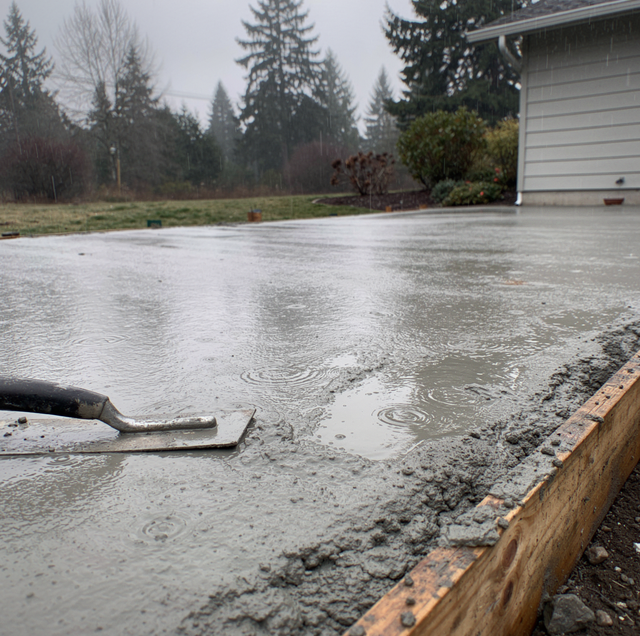
Does rain in the forecast ruin the pour you have booked? The answer turns on how far along the concrete is when the first drops land. Before it stiffens, rain reaching the surface mixes with the cement paste at the top, thinning it, and the thinned paste hardens into a skin that powders under a broom and flakes off in sheets. After it stiffens, the same rain lies on top, watering the slab, as a crew would otherwise do with a hose. Both of those can be true of your slab on the same afternoon. What separates them is a few hours, and those hours are why a crew watches a radar loop as closely as it watches the truck.
What Rain Does to the Paste at the Top
Concrete gets its strength from cement paste that locks the sand and stone together, and that paste weakens as the water-to-cement ratio rises. The reason is chemical. Cement combines with roughly a quarter of its own weight in water; the rest rides along, making the mix workable and leaving capillary space behind as it goes. More water in, more empty space out, and a softer, more porous result.
Rain puts its water in the worst available place, which is the top few millimeters, the layer that has to take a broom, a tire, and a shovel. Run the numbers on a square foot of your slab. A tenth of an inch of rain drops about half a pound of water onto it. The top quarter inch of concrete underneath, for a mix carrying five 94-pound sacks of cement to the cubic yard at a water-cement ratio of 0.50, holds only about a fifth of a pound of mixing water. A light shower can put roughly three times the paste's own water onto the one layer you will actually walk on.
Then the finishing tools drive it home. A float or a trowel passed over a wet surface works that water down into the paste instead of letting it run off, and the diluted skin dusts under traffic and scales away in thin flakes the first time your driveway is asked to hold.
Rain Before the Pour: The Base and the Forms
Rain that falls before the truck arrives never touches the concrete, and it can still be the reason your slab fails. What it works on is everything the concrete is about to sit on.
Start with your forms. Water standing inside them has to come out before any concrete goes in, because concrete discharged into a puddle takes the same dilution at the bottom that rain gives it at the top. The bottom of a slab is the face bearing on the ground, and weak paste there gives no warning at the surface. It waits, and a section breaks under a wheel load years later. Crews pump or sponge the low corners out before the truck backs in.
Then the ground. A saturated subgrade pumps under the wheels of a ready-mix truck and under the crew's own boots, so the grade screeded that morning moves while your concrete is still soft. Running water also finds the seam between the base and the forms and washes fines out from beneath the edge, leaving a void the slab has to span.
This is the stage where the call is to move the date. A sheet over the top does nothing for ground that has already taken up water, and there is no drying out a subgrade on the morning of your pour. Protection covers water arriving after the concrete does; water that got there first is a different problem.
When Does Rain Stop Hurting a Slab?
Concrete stops taking water in at the point where it stops being penetrable, and that point arrives later in the afternoon than the surface looks to you like it should.
There are two stiffening milestones, and the trouble lives in the gap between them. At initial set, the mix can no longer be placed or consolidated, and it holds its shape. But the surface is still open at that moment, because the finisher is still floating and trowelling it, so water landing there has somewhere to go and something to move it. Only at final set does the surface resist an object pressed into it, and that is the line the question turns on. Rain before it thins the paste. Rain after it lies on the surface and soaks in, feeding a reaction that runs as long as water is available.
That is why a crew's mood can change over the course of an afternoon. The same cloud that would have ruined your finish at two o'clock is welcome at six. Cool, still weather makes a rain forecast more dangerous, because hydration slows when the concrete is cold, and your vulnerable window stretches into the evening.
How long before you can walk on your slab, park on it, or build on it is a separate timeline with its own milestones, all of them well past the point this one turns on.
On a slab that took rain before final set, the exposed areas give up sand and powder under a stiff broom while a strip that sat under a sheet does not. Rain after final set sweeps the same everywhere.
Tenting a Pour, and Deciding Not to Pour at All
Protection is a kit, and it goes on the truck before the pour rather than getting hunted down when the sky changes. Polyethylene sheeting is the core of it, held clear of the concrete on a light frame or on stakes and battens so it never touches the finish. Sheeting laid flat on a soft surface prints into it and channels its own runoff onto the slab. The sheet is lapped and weighted at every edge because a gust that gets underneath can take the whole thing across the site.
Insulated blankets do a different job. Concrete generates its own heat as the cement reacts, and a blanket traps that heat in the slab, so the mix keeps moving toward final set rather than stalling in cool air. Shortening the vulnerable window is a form of rain protection in itself.
Then the water on the ground has to go somewhere. A shallow diversion cut on the uphill side of the forms sends site runoff around your pour, and the spoil from that cut goes on the downhill side.
None of that saves a pour that should not happen. When the forecast window is shorter than the time your mix needs to reach final set, or when the base has already taken the water, the crew moves your date and pours into a window it can protect.
The Penetration Reading Behind Final Set
The final set has a number attached to it, and that number comes from a needle. The standard test method for time of setting of concrete by penetration resistance works on mortar sieved out of the fresh concrete through a 4.75-millimeter screen. A needle of known bearing area is pressed one inch into that mortar, and the force is divided by the area. Initial setting time comes when that reading reaches 500 pounds per square inch. Final setting time comes at 4,000 -- an eightfold jump, and the span between the two covers the window this question sits inside.
That figure describes a sample in a container, not the slab in your yard. Nobody takes a penetration reading off a finished surface, and the method makes no promise about your mix or your morning. It does give the term a physical meaning: at 4,000 pounds per square inch, the mortar no longer yields to something pushed into it, which is the condition that stops rainwater from going anywhere.
The crew on your driveway is judging the same transition with a thumb and a boot heel, which is coarser than a graduated needle and lands earlier by design. It is also why the mortar in that container is sieved at all: the needle has to meet paste and sand, with the stone taken out of its way.
Frequently Asked Questions
Less than the forecast implies. Measurable precipitation is defined as 0.01 inches, and a chance-of-rain figure gives the probability that at least that much falls at a point in the forecast area. A hundredth of an inch is about a twentieth of a pound of water per square foot, a quarter again on top of the mixing water in the layer it lands on. Take the hour from your forecast rather than the depth. It matters more to your slab.
Not for long. Discharge must be completed within 1.5 hours of water meeting cement, or within 300 drum revolutions, whichever comes first. A loaded truck cannot sit out a shower on that clock, and what is already on your ground is stiffening anyway. A crew places to a planned edge instead and treats the rest as a separate placement.
Because the clock that matters starts when the concrete does, and its speed depends on the concrete's own temperature rather than the air's. That temperature is taken directly in the fresh mix, by a standard test method, before placement begins. An early start puts your finishing work ahead of the weather and leaves the stiffening hours in daylight, when a crew can still see the surface it is judging and get sheeting over your slab.
They shorten the time to set. Accelerating admixtures fall into two categories: one type accelerates alone, and another that both reduces water and accelerates, and either one brings final set forward. That narrows the hours your slab spends vulnerable. The protection still goes up, though, and the mix is agreed with the ready-mix supplier when you place the order rather than on the day.
Along the outside of the forms. Water running down the form face soaks the ground the stakes bear on, and a stake that loses its grip lets the form bow outward under the concrete's weight. The edge of your slab follows, and you see it afterward as a wandering line or a thick lip at one corner. Crews brace the downhill side for that reason and cut runoff away before it reaches the formwork.
An evaporation rate, worked out rather than guessed. Hot-weather concreting guidance includes a nomograph that converts four readings -- air temperature, concrete temperature, relative humidity, and wind speed -- into a rate of surface evaporation. Above about 0.2 pounds per square foot per hour, or 1.0 kilogram per square meter per hour, protective measures are called for. That is the same water balance your slab faces in rain, running the other way.
If the week around your pour date looks unsettled, the schedule is the first thing to work out — the tenting, blankets and site drainage are staged when the truck is booked, because the morning of the pour is too late to go looking for them. PTTC Concrete LLC serves Olympia, Tacoma, and Lacey. Call (253) 785-2490.
