
Slippery Concrete When Wet? What Your Surface Is Telling You
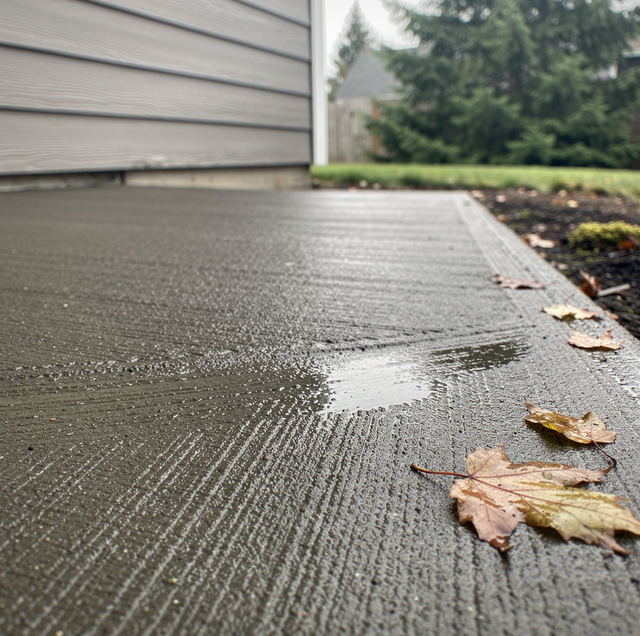
Slip resistance is built into a slab on the day it is finished. Whatever tools pass over the fresh surface decide how much peak and valley the top layer of paste will carry, and that microscopic texture is the only thing a shoe sole has to grab. Dry, almost any concrete feels secure, because rubber makes contact with the paste directly. Wet, a thin film of water sits between the two, and grip depends entirely on whether that film has somewhere to escape in the instant a foot lands.
A surface that feels solid dry and treacherous wet is describing its own texture, not the weather. Rain only reveals how little profile was left at the top of the slab. Every cause below moves the same single variable: how much open texture survives where the shoe meets the concrete.
Quick Answer: Concrete goes slick when its surface texture closes up or gets covered. A hard-troweled finish, a glossy film-forming sealer, biological growth, chalky residue, standing water, and years of traffic wear all reduce the grip a wet shoe can find.
How the Finish Decides Traction
Fresh concrete is finished with tools that either open the surface or close it. A steel trowel, run in repeated passes as the slab stiffens, presses the paste flat and drives the fine particles down into the pores. Do that long enough and the top becomes dense and burnished, with a faint sheen and almost no profile left. That is precisely what an interior floor wants: easy to sweep, easy to coat, bright under overhead light.
A broom finish leaves the surface open. Stiff bristles are dragged across the slab while it is still plastic, cutting parallel ridges and valleys into which a water film can be pushed as weight comes down. A float finish, worked with a magnesium or wood float and stopped there, leaves an open sandy texture that works the same way. Both give a wet sole somewhere to make contact, at the cost of the polished look.
Exterior slabs end up wearing interior finishes more often than you would expect. A crew finishing a garage floor or a shop slab carries the same trowel routine out onto the adjoining walkway. A homeowner asks for the smooth, uniform surface they admired on an indoor floor, and gets it. The problem is not poor workmanship; a hard-burnished slab is skilled work placed where it cannot do its job. Once that surface has cured, its texture is fixed, and no amount of cleaning brings back a profile that was never left there.
Glossy Sealer and the Missing Anti-Slip Additive
How many coats a slab has on determines more about its traction than which product was applied. One thin coat of a film-forming sealer drapes over the texture and follows its shape, and the profile survives underneath it. Coat after coat, or a single heavy application laid on to chase gloss, fills the valleys and levels the peaks until the slab is wearing a smooth plastic skin. Dry, the skin still offers some grab; wet, water spreads across it in an unbroken sheet with nothing standing proud for a sole to catch.
Coat build shows at the edges. Where a film-forming sealer has been recoated over years, the slab edge and the base of an adjoining wall carry a thicker, slightly amber lip, the easiest place to judge how many coats are on.
An anti-slip additive fixes the geometry. Fine grit suspended in the sealer as it goes down leaves thousands of hard points sitting just above the film, so the coating protects the concrete without erasing what makes it safe to walk on. Left out, a sealer applied for the best of reasons can turn a well-broomed walkway slick. If a slab started slipping within days of being coated, the coating is the variable that changed, and the coating is where the answer lives.
Efflorescence, Dust and Growth as Loose Layers
Water moving through a slab leaves dissolved salts on the surface as it evaporates, and underfoot that white powder is a loose layer. A loose layer between rubber and concrete rolls, which is the whole of what traction cares about.
Ordinary surface dust does the same work. Pollen, fine soil washed out of a planting bed, silt off a roof, the chalky residue that gathers on a slab nobody walks on much: all of it sits on the texture instead of in it. Dry, you feel a slight looseness underfoot. Wet, the powder turns into a slurry, and the foot slides on it while the concrete underneath keeps every bit of its profile.
A thin biological film works the same way from the other direction. Algae and the dark growth that appears wherever a surface stays damp hold water against the concrete and shear under load, so traction drops while the slab beneath is unchanged. The texture is still down there doing nothing, because the shoe never reaches it.
This is a cause easily mistaken for a bad slab, because the surface looks and sounds sound. The test is whether traction comes and goes with the layer. A patio that grips for a week after a hard rain washes it clean, then goes slick again as the powder rebuilds, is telling you the trouble lives on top of the concrete.
Standing Water Deeper Than the Texture
Depth is what decides grip here. A broom profile works by giving the water film somewhere to go in the fraction of a second when weight transfers onto the foot. Once standing water is deeper than the grooves, that escape route is already full before the shoe arrives, and the sole rides on water. A texture that performs well on a wet but draining surface can perform very differently on the same slab under a held film.
Water stands where the slab has no fall, or where it has settled since it was poured, and the low spots hold a sheet of it long after the rain stops. For traction, that makes a marginal surface dangerous on a schedule nobody can predict, because the puddle is not always in the same place and is hard to see on a gray day. Fixing the fall changes how often water stands there. The finish stays what it was, so a flat-troweled slab that no longer ponds is still a flat-troweled slab.
Traffic Wear on a Broom Finish
A broom profile is shallow by design. It has to be, or the surface would be miserable to sweep and hard on bare feet. Shallow texture also means there is not much material to lose before it is gone.
Feet, tires, dragged furniture, and repeated cleaning all abrade the tops of the ridges. The wear is never even. Wheel paths on a driveway and the walking line down the center of a path go smooth first, while the last few inches next to the edge keep their texture because nobody steps there. That uneven pattern is a useful thing to look for, and it is why a walkway can feel secure at the sides and untrustworthy down the middle.
Aggressive washing accelerates the same process. Water at high pressure erodes the soft cement paste that holds a broom profile in shape, and a surface washed that way can come out looking cleaner and gripping worse, with aggregate standing exposed and the fine texture between it stripped away.
An over-pressured wash erodes the cement paste that holds a broom profile together, leaving a surface that looks cleaner and grips worse. Slip resistance on stairs and pool decks is a real injury risk, so treat those areas with particular care.
Reading Your Own Surface
Almost all of this is visible without tools if you know what to compare.
Run a dry hand across it: Burnished paste feels glassy and slightly cold, with nothing for a fingertip to catch. A broom or float finish drags on the skin. Do it in two places, one traveled and one protected.
Find a strip nothing touches: Under a step overhang, behind a planter, along a fence line. If that strip carries ridges and the middle of the walkway is smooth, wear is your answer.
Look at the sheen from a low angle: A film-forming sealer shows a gloss that shifts as you move, often with a visible line where the applicator stopped or overlapped. Those two signs are what identify a film. Tight beading only tells you some sealer is still working, since a penetrating sealer beads just as hard and leaves nothing standing on the surface at all.
Wipe with a dry dark cloth: White powder on the cloth means a loose layer is part of what you are feeling.
Notice when it is slick: Slick everywhere and always points at the finish. Slick starting the week it was coated points at the sealer. Slick only where the surface stays damp and shaded points at growth. Slick only in one low corner points at water.
Most slick slabs are running two of these at once: a finish that was always closer to smooth than it should have been, plus something sitting on top of it. Sorting out which layer is doing the work matters because the layers that sit on the surface can come off, whereas the one built into the slab cannot. A slab whose texture was closed at finishing will not improve with cleaning, and changing that surface is real work worth planning early.
Frequently Asked Questions
It does. Bristle marks pulled across the line of travel give a foot something to catch at every step, because the ridges sit at right angles to the direction a shoe wants to slide. Marks pulled the same way people walk, or straight down the slope, drain nicely and offer a sliding foot very little to work against. On a walkway, that means brooming across the path.
Vehicles carry water in and drop most of it in the first stretch inside the opening. Tires also leave a trace of rubber and road oil there, and that residue builds into a thin film slicker than the concrete under it. A floor that grips at the back and slides at the front usually has a residue band at the entry, while the concrete itself is the same throughout.
Slightly. The grit is fine enough to disappear at normal viewing distance, but it takes some of the wet-look sheen off a glossy sealer and leaves a faint sandy feel underfoot that most people notice barefoot and nowhere else. It also settles quickly in the bucket, so it has to be kept stirred throughout the application, or coverage comes out patchy.
Often, and the reason is in how the pattern gets there. The mat is pressed into paste that was troweled smooth first, so the high points of the design, which are the parts a foot actually lands on, carry the closed surface a trowel leaves behind. The low joints sit below the tread and hold water, so the foot never reaches the part of the surface where the water went.
A mat covers the problem and adds two of its own. It traps a damp band underneath that stays wet long after the rest of the surface dries, and its edges curl and shift, so the mat becomes something to catch a toe on. Coir and rubber runners also hold grit that grinds at the surface beneath them. Treat one as a stopgap while you sort out the cause.
The nosing, meaning the leading edge of each tread, takes the most concentrated wear on any set of steps, because every foot loads it and pivots over it. Texture vanishes there first, and the edge itself rounds off, which lets a foot slide forward as well as down. That is the worst possible place to lose grip, and it is where you should look first.
Losing your footing on a slick walkway or patio — get the finish, any coating, and the slope assessed together, since traction trouble usually comes from more than one of them at once. PTTC Concrete LLC serves Olympia, Tacoma, and Lacey. Call (253) 785-2490.
