
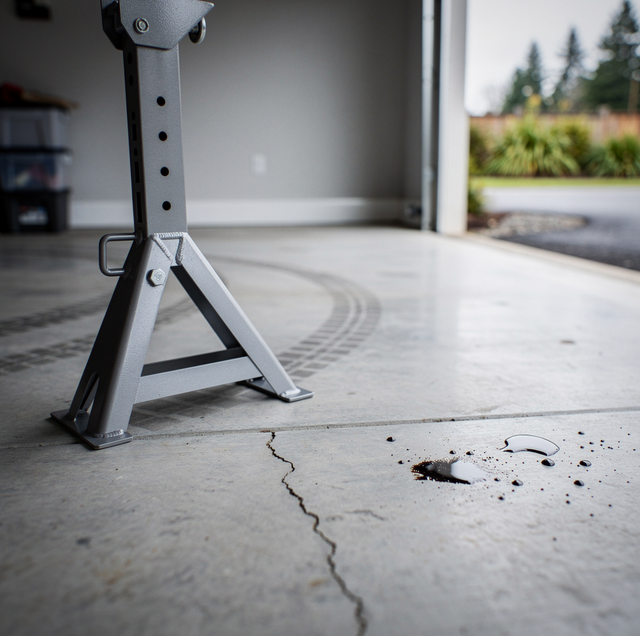
A crack runs the length of a garage floor that has never seen frost, never had a tree root beneath it, and never sat in standing water. The slab is sheltered from nearly everything that breaks up a driveway outside. It cracked anyway.
Your garage slab carries loads your driveway never sees, and it sits over ground you cannot inspect once your concrete is down. What cracks your floor are three mechanisms you will not meet on your driveway: the weight you set on a single jack stand, the moisture your slab quietly draws up from underneath, and the coating you rolled over a crack you had not seen move.
Why a Sheltered Garage Slab Cracks With No Frost or Roots Working On It
Concrete cracks when something pulls it apart faster than it can stretch. Outdoors, that force usually arrives from the ground: frost heave, a thickening root, a base washing out from under one corner. Your garage slab is shielded from all three, which is why you did not expect this one.
What is left indoors is a shorter list, and every item on it works on the concrete itself: the slab shrinking as it dries, a load pressed into a small footprint, and water arriving from below as vapor. Your floor sees all three at once.
Shrinkage Comes First, and the Control Cuts Aim It at a Straight Line
Fresh concrete gives up water as it cures and shrinks in the process. The slab is held at its edges and by friction against the base, so the shrinking material pulls against itself until it lets go somewhere. That first crack is not a defect in the mix.
Expansion joints and control cuts prevent that random cracking and give the natural movement somewhere to go. A control cut is a groove tooled or sawn into the slab, so the shrinkage crack forms inside the groove, under the surface you walk on and away from your tires. Cut spacing is capped at 24 to 36 slab thicknesses.
A Jack Stand Puts the Whole Corner of a Vehicle on a Few Square Inches
A car sitting on its tires is a gentler load than it sounds. Each tire spreads its share of the weight over a contact patch of a few dozen square inches, and four of those patches distribute a couple of tons across a wide area of slab. Concrete handles that comfortably. The trouble starts when the same weight is handed to something with no footprint at all: the base plate of a jack stand, the saddle of a floor jack, the leg of a storage rack loaded with tools. The load has not changed. The area carrying it has shrunk by an order of magnitude.
Concrete is strong in compression and much weaker in bending and in shear, and a point load tests both weaknesses at once. Under a stand, your slab is pressed down while concrete inches away is not, so the material between them is being sheared. If the base under that spot is fully compacted, the load passes straight through into the ground. If there is a soft pocket, a void where backfill settled, or a trench line where a plumbing run was cut, the slab has to span it, and a point load over a span is the hardest case a garage slab meets.
You will rarely see the failure the day it happens. A stand set on the same square of your floor through a dozen jobs works that spot repeatedly, and concrete you have flexed past its limit does not spring back. What turns up later is a short crack near where you jack, sometimes with a shallow cone of concrete pushed out around it, and a lip you can feel underfoot. If your garage doubles as a shop, you already know the spot.
Ground Moisture Arrives at a Garage Slab as Vapor and Leaves as a Stain
Soil under your slab is almost always damp, and concrete is porous enough for that dampness to travel. Water in the ground evaporates into the pore space beneath the floor, and because the air in your garage is drier than the earth beneath it, the vapor rises through the concrete until it reaches the surface and escapes. On a bare floor, that traffic is invisible: the vapor evaporates off the top as fast as it arrives, and nothing on the surface changes. Dissolved salts carried up with the water cannot evaporate, so they stay as a chalky white bloom, and a slab showing one is a slab with water still moving through it.
A patch that stays damp under a parked car, or darkens after a wash and never quite dries out again, is quietly doing the same thing faster than the rest of your floor.
That moving water does not crack concrete by itself, but it changes what your slab will tolerate. Salts crystallizing in the pores push the paste apart from inside, which is why a floor with heavy bloom often has a dusty, friable top layer and shallow spalling along a crack. Once a crack is open, it becomes the easiest path for the vapor, and you will find its edges breaking down faster than the floor you park on.
Why a Fresh Coating Peels Along a Crack That Has Not Stopped Moving
Epoxy and polyaspartic systems bond only to the concrete they are rolled onto, while the crack beneath keeps moving. The coating is a film a few thousandths of an inch thick, and a moving slab will open and close underneath it. A film that cannot stretch tears, and the tear appears as a hairline in your finish over the crack.
The two failures on an epoxy floor are peeling and delamination, and both begin in one place: a spot where the coating never got a grip, or where the concrete moved. Filling and bridging a live crack before your coating goes down separates a floor that keeps its finish from one where you see the crack again in a season.
The Moisture Test That Belongs on the Slab Before a Coating Goes Down
Vapor moving through a slab is measurable before you open a pail of coating, and two standard test methods do it. In one, a dish of anhydrous calcium chloride sits under a sealed dome on your floor and is weighed after 60 to 72 hours, giving a moisture vapor emission rate in pounds per thousand square feet per 24 hours.
In the other, a probe is inserted into a hole drilled to 40 percent of the slab depth and measures the relative humidity in the concrete after 24 hours. The number that clears one coating will not clear the next, so the limit comes from the maker's data sheet. Testing runs with your heating and cooling on for 48 hours, because a garage shut all week will not give you the number it gives in service.
Which Cracks in a Garage Floor Need More Than a Bag of Filler?
Two things separate a crack that needs filling from one that needs a look below your floor: movement, and support beneath it. A crack holding one width through a year is behaving like shrinkage. One that is opening, or out of plane, has its cause under your slab rather than in it.
Sorting those apart comes down to width, direction, and offset checks. For your garage floor, add one more: whether the crack follows a control cut or crosses it.
What Chasing a Crack Inside a Closed Garage Really Involves
A crack that will carry traffic is not filled as it sits. The repair starts by opening it into a square-sided channel so the filler has sound concrete to grip, and in your garage that means cutting concrete in a closed building. Bonding agents key the patch to the slab.
Chasing a crack means cutting concrete indoors, and that dust is respirable crystalline silica, so the cut belongs to a crew already working wet or on shrouded HEPA extraction, and not to you.
Grinding and leveling are machine work. A walk-behind grinder or slab saw kicks when it binds, and a gas machine adds carbon monoxide to a closed garage, so it belongs to a crew with electric equipment and the door open. Keep your jack and stands off the slab until it is sound.
Frequently Asked Questions
Often, yes. The two routes are patching the affected areas with a concrete filler, or resurfacing your entire floor when the damage is widespread enough that individual patches would show. Which one suits you depends on how much of your floor is affected and whether your finish has to match.
On a basement or garage slab, the answer has two parts: seal your floor, and apply a moisture barrier. The sealer closes surface pores so vapor cannot pass out freely, and the barrier coat holds back the vapor pressure behind it. Neither substitutes for correcting drainage that puts water against your foundation, and you will repeat the work until you do.
Frequently, and the two turn up together. Leveling corrects surface irregularities: professional grinding equipment removes high spots, while specialized underlayments fill low areas, with attention to maintaining your drainage slope. A crack in your floor that has gone out of plane is the first thing you notice when a floor drifts out of level, so your crack and the unevenness are assessed as a single piece of work.
Not by itself. Your car spreads its weight across four contact patches and asks less of your concrete than the thickness poured for a garage, which runs four inches over a compacted base, and five or six inches where a truck, an RV, or a lift will sit. The bigger question is the support under your slab, and whether you concentrate that weight onto a jack, a stand or a rack leg.
Yes, and for a reason that is not cosmetic. An open hairline in your garage floor is a path for whatever lands on your floor: road salt carried in on tires, oil, brake fluid, wash water. Those work down into the crack and the base under it, and a filled crack keeps them on the surface where you can wipe them away. A semi-rigid filler is the choice on a floor that moves with temperature, because a rigid one cracks again alongside your repair.
Because it belongs under your concrete, and once the concrete is there, that space is gone. A basement installation includes vapor barriers and waterproofing measures to protect against ground moisture, and those go on the prepared base before concrete is placed. Your garage pour gets the same, with expansion joints and moisture barriers built in to prevent future problems. Nothing applied to the top of your finished slab occupies that position. A surface product can slow vapor coming out of your slab, and a good one earns its place, but it works against the vapor pressure instead of ahead of it. You get one chance at a barrier, on the day your base is prepared.
A cracked garage slab is worth having looked at before a coating or leveling job goes over it — our crew can measure the crack, check whether the slab is still moving, and lay out whether a patch, a resurface, or grinding and underlayment is best for your floor. PTTC Concrete LLC serves Olympia, Tacoma, and Lacey. Call (253) 785-2490.