
Concrete Control Joints: Where Cracks Go to Hide
Quick Answer: Control joints are planned grooves cut or tooled into a slab, usually about one quarter of the slab's depth, that create a deliberate weak line. Because the slab is thinnest there, the inevitable shrinkage crack forms underneath the joint in a straight, hidden line instead of wandering across the surface.
A fresh concrete slab looks solid and permanent the day it is finished, but it is already changing under the surface. As the mix loses water and the temperature swings, the slab pulls inward and moves. It will crack. That is not a defect and not a sign of poor work. It is what concrete does. The only real question a good crew can answer is where those cracks show up, and control joints are the tool that answers it.
Concrete Shrinks, and It Will Crack
Concrete gains strength as the cement reacts with water, a process called curing. During that same window, the slab is also giving up excess moisture to the air, and as it dries it shrinks. A typical slab pulls in a small but real amount, often around a sixteenth of an inch for every ten feet of length. That sounds trivial until you remember the slab is rigid, bonded to the ground below, and tied to whatever it was poured against. It cannot shrink freely, so tension builds inside it.
Temperature adds a second pull. Concrete expands when it warms and contracts when it cools, and it does this every day and every season, not just once. A slab baking in afternoon sun and then cooling overnight is being stretched and squeezed on a daily cycle. Cold weather shrinks the same slab and makes it more brittle, while heat and constant cycling work on it the rest of the year. Neither one is the whole story, so a slab is never really at rest.
When the internal tension climbs past what the concrete can hold, the slab relieves it the only way it can, by cracking. There is no mix design, no amount of skill, and no reinforcement that stops this entirely. Rebar and welded wire hold the two sides of a crack tightly together so it stays hairline instead of gaping, but they do not prevent the crack from forming. Accepting that cracking is inevitable is the starting point for everything that follows.
What a Control Joint Actually Does
Since the slab is going to crack somewhere, the smart move is to decide the location in advance. A control joint, also called a contraction joint, is a groove that runs across the slab and removes part of its thickness along a straight line. By thinning the concrete there, the joint creates the slab's weakest cross section.
Tension always finds the weakest point. When the slab reaches its cracking limit, the crack starts at the bottom of that groove and travels straight down through the remaining thickness, staying hidden inside the joint line. Instead of a jagged crack snaking diagonally across an otherwise clean surface, you get a neat, mostly invisible separation exactly where the crew planned it. The crack still happens. It is just guided.
The depth of the groove is what makes this work. The rule of thumb is to cut or tool the joint to roughly one quarter of the slab's thickness.
Cut or tool the joint to roughly one quarter of the slab's thickness, so a four-inch slab gets about a one-inch groove. That relationship between groove depth and slab thickness is the single most important number in the whole subject.
Where the Joints Go: Spacing and Layout
Cutting one groove does not save a large slab. The joints have to be spaced closely enough that no single panel builds up more tension than a joint can relieve. A common guideline puts the spacing at roughly twenty-four to thirty times the slab thickness, measured in feet. A four-inch slab lands somewhere near eight to ten feet between joints, while a thicker six-inch slab can stretch closer to twelve or fifteen.
Shape matters as much as distance. The goal is to keep each panel as square as possible, because long, narrow rectangles crack across their middle no matter how the joints are spaced. Crews aim to keep the length of a panel no more than about one and a half times its width. A driveway laid out in tidy squares behaves. The same driveway divided into long skinny strips will crack right through those strips.
Reentrant corners need extra attention: Any inside corner, such as where a patio wraps around a step or a slab notches around a post, gathers stress at that corner. Cracks love to run straight out from an inside corner at an angle. A control joint placed to run from that corner cracks a planned path before it starts one of its own.
The Three Joint Types by How They Are Made
Control joints get formed in three main ways, and the choice comes down to timing and finish.
Tooled joints: While the concrete is still wet and being finished, a worker runs a hand tool called a groover along a straightedge to press a rounded channel into the surface. This is the fastest method and needs no extra step later, which suits sidewalks and smaller residential flatwork. The tradeoff is depth. Hand tooling rarely reaches a full quarter of the slab thickness on anything but a thin slab, so it is best on slabs where that quarter depth is shallow to begin with.
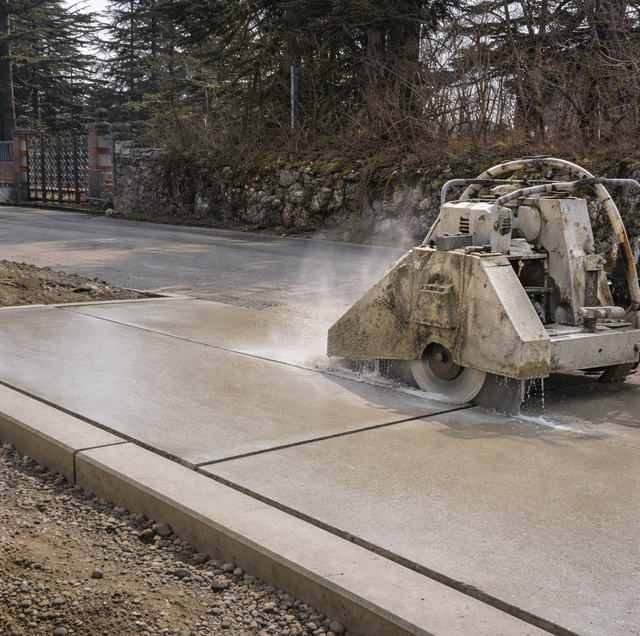
Sawcut joints: Once the slab has set enough to walk on, a saw with a diamond blade cuts a clean, narrow groove down into the hardened concrete. Sawcutting reaches full depth reliably and leaves a crisp line, which is why it dominates on larger pours, garage floors, and commercial work. The catch is timing, covered below.
Preformed joints: A thin plastic or fiber strip is set into the wet concrete and left in place, forming the weak plane as the slab hardens around it. These show up in decorative work and in places where a crew wants the joint located precisely without a later saw pass.
Cutting hardened concrete releases silica dust, which is hazardous to breathe. Sawcutting is professional work done with a wet saw or a vacuum shroud and a proper respirator, not something to try with a dry blade and no protection.
Timing is everything for sawcuts: A sawcut joint only works if it is cut during a narrow window, usually within the first several hours after finishing and often well under twelve. Cut too early and the blade tears and ravels the soft edge. Wait too long, and the slab has already relieved its tension by cracking on its own, so the joint arrives after the damage is done. Crews watch the slab closely and cut as soon as it is firm enough to hold a clean edge.
Control, Construction, and Isolation Joints Are Not the Same
The word joint covers three different jobs, and mixing them up leads to slabs that crack in the wrong places.
A control joint, the subject here, is a planned weak line inside a single continuous pour that steers shrinkage cracking. The concrete is still connected across it. It is simply thinned.
A construction joint is where one pour stops and another begins, usually because the whole job could not be placed in a single day. It is a real edge between two separate placements, often keyed or doweled together with steel bars so the two slabs stay level and share load across the seam.
An isolation joint, sometimes called an expansion joint, does the opposite of connecting. It fully separates the slab from anything rigid it touches, such as a foundation wall, a footing, a column, or a step. A compressible strip fills the gap so the slab can move, shrink, and swell without transferring that movement into the wall or cracking against it. Picture two neighbors sharing a fence but keeping a gap between their sheds so neither one's settling pushes the other over. That gap is what an isolation joint gives a slab.
Why Too Few or Too Late Means Random Cracking
A slab poured without a solid compacted base, without reinforcement, or without enough joints in time is set up to crack wherever it wants. Skip the joints and the whole slab acts as one oversized panel, building tension until it fractures on a line of its own choosing, usually a diagonal that runs straight across the finished surface. Space the joints too far apart, and each panel is still large enough to crack in its middle before the joint can help. Cut them too late, and the slab has already made its own crack.
The result of any of these is the same: random cracking that a homeowner reads as a failure. In most cases, the underlying slab is fine. It was not told where to crack, so it improvised.
Keeping Joints Working: Maintenance and Sealing
A joint is an open groove, which means it is also a path for water and grit to reach the base under the slab. On exterior flatwork, filling the joints with a flexible sealant keeps water out while still allowing the slab to move as it expands and contracts. A rigid filler would crack the moment the slab shifted, so joint sealants are made to stretch.
Sealant does not last forever. It collects dirt, dries out, and pulls away from the joint walls over years, so an occasional cleanout and refill keeps it doing its job. Isolation joints against walls benefit from the same attention, since a failed filler strip lets water sit where the slab meets the structure.
One more distinction is worth holding onto. A thin, tight crack that follows a joint line is a shrinkage crack, and it is cosmetic. A wide crack, offset so one side sits higher than the other, or actively growing is a different matter and should be looked at by a professional rather than sealed over.
Frequently Asked Questions
You can cut a groove into old concrete, but it will not pull an existing crack back into line, and it may not prevent new ones. A saw joint attracts cracking only while the slab is still building shrinkage tension, mostly in the first weeks. On a slab that cured years ago, cutting is mainly cosmetic or used to isolate a section before a repair, not a substitute for joints placed at the time of the pour.
No. A control joint only removes about a quarter of the thickness. The remaining three-quarters stay intact and keep carrying load across the joint, which is why a properly jointed slab still feels solid underfoot. The crack that forms below the groove is thin and held tight by the concrete and any reinforcement, so the joint reads as a line rather than a gap.
Most control cuts are narrow, on the order of an eighth of an inch, made by a single diamond blade pass. The point is to create a weak plane, not to remove material, so a thin kerf does the job. Wider cuts are reserved for joints that will receive a bulky sealant or that double as a decorative reveal, and those are planned for that width from the start.
No. Steel and synthetic fibers control the width of a crack once it forms, keeping it hairline, but they do not remove the shrinkage tension that causes cracking. You still need joints to choose the location. Reinforcement and joints solve two different halves of the same problem, and leaving either one out shows up in the finished slab.
Those are decorative sawcuts that double as control joints. Laying the cuts in a diamond or grid turns the necessary joint lines into a pattern, so the slab gets its planned weak planes while the surface looks intentional. The spacing rules still apply underneath the design, meaning the pattern has to keep the panels reasonably square to actually control cracking.
The likely causes are joints spaced too far apart, cut too shallow, or cut too many hours after the pour. Any of those lets tension win before the joint can relieve it. A weak or uneven base under the slab does the same, since a soft spot lets one area settle and crack independently. If the crack is fine and follows a joint, it is doing its job. If it wanders and is wide, the layout or base is worth a professional look.
Planning a driveway, patio, or garage floor and want the joints done right the first time — a properly jointed slab cracks where you want it, not where you don't. PTTC Concrete serves Olympia, Tacoma, and Lacey. Call (253) 785-2490.
