
Why Is My Concrete Slab Sinking or Uneven?
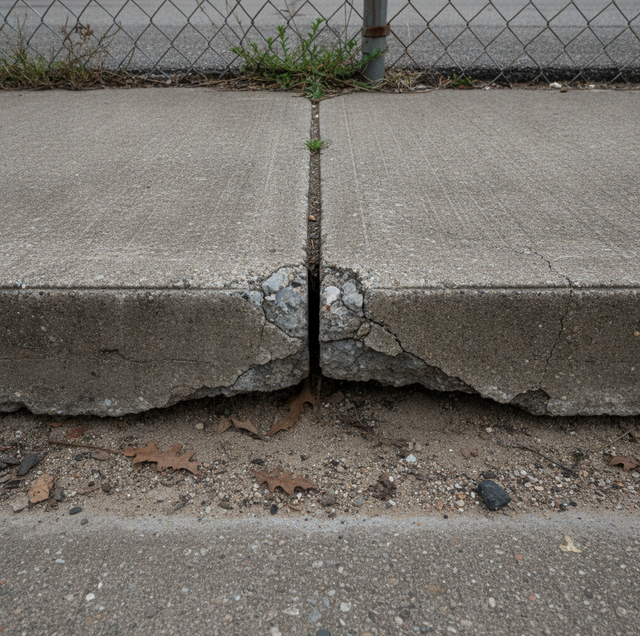
A patio that once sat flush with the door now steps down at one edge. A driveway panel has tipped so rainwater runs the wrong way, and a sidewalk joint has risen into a toe-catcher. Concrete this heavy does not move on its own. When a slab sinks or goes uneven, the ground carrying it has changed, and the slab follows. Reading what shifted underneath is the whole job, because the same lift that raises the slab back to level will not hold unless the reason it dropped gets fixed first.
The Real Problem Is the Ground, Not the Concrete
A slab is a rigid plate resting on whatever was packed under it, usually a layer of compacted crushed rock, called the subgrade or base, over native soil. The concrete itself is rarely the thing that fails. What fails is the support: the base settles, erodes, or was never packed tight to begin with, and a gap opens between the underside of the slab and the dirt. With nothing holding that section up, the slab's own weight breaks it downward into the empty space. So a sinking slab is almost always a base-and-soil story, and the concrete is the messenger, not the culprit.
That distinction matters because it changes the fix. Patching the surface or grinding down a high edge treats the symptom and buys a few months at most. The slab keeps moving until the void or soft spot beneath it is filled and the water that hollowed it out is sent somewhere else.
What Actually Pulls a Slab Out of Level
A handful of causes account for most sunken and tilted slabs, and they often stack on top of each other.
Poor compaction at pour time: If the base was not tamped to full density before the concrete went down, the loose fill keeps settling under load for years. This is the classic cause behind a slab that sinks fairly evenly across its whole footprint rather than at one spot.
Water washout and erosion: Moving water is the biggest offender. A downspout dumping at the slab edge, a gutter overflowing, or ground graded to run toward the slab instead of away from it will carry fine soil out from under the concrete grain by grain. Over time, that scouring leaves a hollow, and the slab drops into it. Washout usually shows up first at the corner or edge nearest the water source.
Expansive and organic soils: Fine clay-heavy soils swell when they soak up water and shrink back as they dry, heaving the slab up and dropping it repeatedly until it no longer sits flat. Soils with buried organic matter (old topsoil, roots, wood debris) compress and rot away, leaving the slab unsupported.
Voids from decay and loose fill: A slab poured over buried stumps, construction debris, or uncompacted backfill loses support as those materials break down or consolidate. Decayed tree roots leave tunnels; a filled-in trench that was never packed keeps sinking for years.
Nearby trees and heavy loads: Large roots draw moisture from the soil during a dry stretch, shrinking the soil and allowing the slab to settle over the root zone; then the ground rebounds when it rewetts. A slab that gets loaded beyond what its base was built for (a delivery truck on a walkway-grade pour) can press the base down in one event.
Reading the Slab: Which Cause Is Yours
The pattern of the movement points back to the cause, and you can often narrow it down before anyone digs.
| What you see | What it usually means |
|---|---|
| Drops at the corner or edge by a downspout or low spot | Water washout eroding the base |
| Settles fairly evenly across the whole slab | The base was poorly compacted at the pour |
| Rises and falls with the seasons, cracks that open and close | Expansive clay soil swelling and shrinking |
| Hollow, drum-like sound when you tap it | A void has opened directly under that section |
| One side sits higher than the other at a joint or crack | Differential settlement, one part lost support, the neighbor did not |
That hollow sound is the single most useful test you can run yourself. Tap across the slab with a hammer handle or a length of pipe: solid support rings dull and flat, while a section over an open void answers back hollow and drum-like. Pair a hollow spot with a nearby water source, and you have both the mechanism and the reason in about a minute.
Why Wet Ground Here Makes It Worse
Soil moisture is the engine behind most of this, and it swings hard in both directions through the year. Through the long wet stretch, saturated ground stays soft, drainage backs up, and any downspout aimed at a slab has months of runoff to scour the base. Then, in the dry warm months, the same fine soils shrink as they give up that water, pulling support out from under the slab from a different direction. A slab sees both states, which is why one that looked fine for years can start moving once drainage falls behind, the ground under it is being loaded, softened, eroded, and shrunk in turn. Fixing where the water goes is not a seasonal chore; it is what keeps the base intact every month.
How a Sunken Slab Gets Lifted Back
When the concrete itself is still sound (cracked in a line or two but not shattered), it can usually be raised rather than torn out. Two methods do this.
Mudjacking, also called slabjacking, pumps a cement-and-soil slurry through holes drilled in the slab. The slurry fills the void and floats the concrete back up to level. It uses heavier material, the drill holes are larger, and it is the older, lower-cost approach.
Polyurethane foam injection pumps a two-part foam through much smaller holes. The foam expands in the void, lifts the slab, and cures hard within minutes. It weighs a fraction of a slurry (so it adds far less load to soil that was already too weak to hold the slab), and because it is a plastic, it does not wash out or absorb water the way a mud slurry eventually can. That water resistance is why foam is often the better match for a slab that sank from washout in wet ground.
Lifting only works while the slab is structurally intact. Once concrete is broken into several pieces, badly spalled, or crumbling at the edges, there is no solid plate left to raise, and the honest answer is replacement, removing the old slab, rebuilding and compacting the base, correcting the drainage, and pouring fresh concrete. A pro weighs the number and width of cracks, whether pieces move independently, and the condition of the base before calling lift versus replace.
Fix the Water First, or It Sinks Again
The lift is the visible half of the job; the drainage is the half that makes it last. If a slab dropped because a downspout eroded its base, raising it does nothing about the downspout: the water keeps running, the base keeps washing out, and the slab settles a second time. Redirecting downspouts well past the slab, extending or burying drain lines, and regrading so surface water sheets away from the concrete are what stop the cycle. A good repair pairs the two: fill and lift to fix the slab, and drainage and grading to fix the cause. Skip the second half, and the first half is temporary.
What to Take Away From an Uneven Slab
An uneven slab is a readable problem. The direction and pattern of the drop tell you whether water, poor compaction, or shifting soil is behind it; a hollow tap confirms a void; and the concrete's own condition decides whether it gets lifted or replaced. None of that is guesswork you have to do alone, but knowing what the slab is telling you means you can ask the right questions, and make sure the water that started the whole thing gets fixed alongside the concrete, not after it moves again.
Frequently Asked Questions
Check the slab against a reference that has not moved, the house wall, a threshold, a fixed post, or the far end of the same slab. If the surface steps down away from that fixed point, the slab loses support and settles. If instead it steps up toward a tree, a buried root, or a spot where clay soil is swelling, the slab is being pushed up from below rather than dropping. Lying a straight board or a level across the panel and sliding it toward each edge tells you fast which end is left of the plane. It is a useful distinction because settlement gets solved by filling a void, while heave gets solved by managing the moisture or roots doing the lifting.
Usually not. A driveway, patio, or walkway is flatwork; it sits on its own shallow base and carries no part of the house, so when it sinks, it is telling you about its own subgrade, not the structure. Those slabs are also poured thinner and are simply expected to move more. The exception is a slab poured against the house, or a garage floor: if that concrete drops and pulls a gap open along the wall, or if you also see doors sticking or cracks stepping through interior drywall, the movement may reach the foundation and warrants a closer look rather than a simple lift.
Neither is universally better; they fit different situations. Mudjacking's slurry is cheaper per job and works well for large, heavy slabs where the added weight is not a concern and precision is less critical. Polyurethane foam wins where the soil is already weak, where you want minimal disruption from small drill holes, or where water was the cause. The foam does not wash away and cures fast enough to use the surface the same day. Foam also tends to resist re-settling better on soft ground because it loads the base far less. On a large void or a big commercial slab, foam's expansion covers ground that a slurry would struggle to reach evenly.
Not all of them, and thickness and reinforcement decide as much as the cracks do. Lifting relies on the slab acting as one solid plate that floats up as a unit, so a panel broken into pieces that move independently, one that's deeply spalled or crumbling, or a thin, unreinforced pour that would crack apart under the lifting pressure, is past saving and gets replaced. A thicker, reinforced slab with only a tight crack or two is an ideal candidate, because it stays rigid while the foam or slurry raises it. Access matters too, since the crew needs room to drill and inject, but the small patched holes don't rule out stamped or decorative surfaces, which lift fine. The honest test is whether there's still an intact plate to raise; once it's more like a reassembled jigsaw, tear-out and repour is the sound call.
A hollow ring indicates that a void has already opened beneath that section, even though the surface has not yet dropped. It is an early warning, not an emergency; the slab is bridging the gap on its own strength for the moment. But a bridged void is on a clock: the next heavy load, saturated stretch, or bit more erosion can be what finally breaks it down into the hole, and once it cracks through, the fix jumps from a simple fill to a lift or a pour. Catching a void at the hollow-sound stage often means it can be filled before the slab ever visibly moves, which is the cheapest and least disruptive point to deal with it.
Two reasons that outrank appearance. First, a lifted joint or a dropped edge is a trip hazard, the raised lip at a sidewalk seam or a tipped panel is exactly the kind of catch that causes falls, and it worsens as the movement continues. Second, a slab that has tilted often now drains the wrong way, sending water toward the house instead of away from it. That misdirected runoff pools against the foundation and feeds the same base erosion that sank the slab in the first place, so an uneven slab can quietly become the source of the next drainage problem. Correcting the level restores both safe footing and the intended slope of the water off the concrete.
If a slab of yours has dropped, tilted, or sounds hollow underfoot, we can find the cause and recommend the right lift or repair. PTTC Concrete LLC serves Olympia, Tacoma, and Lacey. Call (253) 785-2490.
