
Concrete Base Prep: The Excavation Steps That Matter
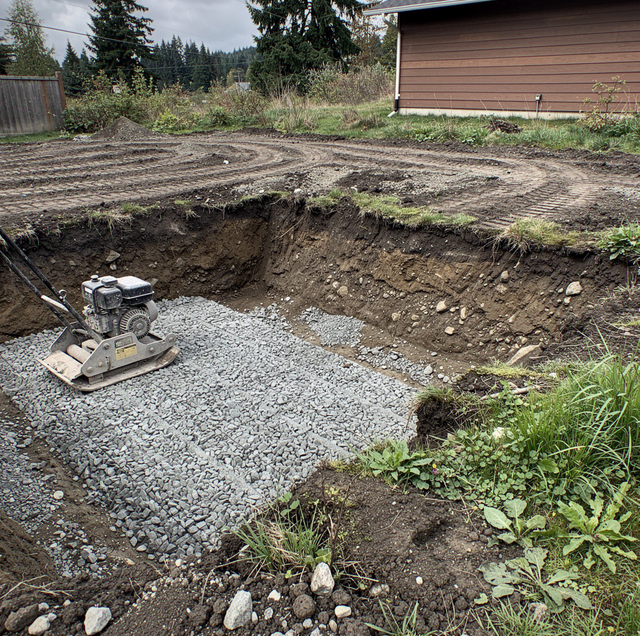
Why does one concrete slab hold up for decades while another, poured from the same truck by the same crew, starts cracking and sinking within a couple of years? The concrete mix itself is rarely to blame. The real difference is buried and invisible once the job is finished: how deep the excavation went, how well the soil underneath was compacted, and what kind of base material was placed and packed down before a single form went up.
Why Excavation Depth Isn't a Guess
Excavation for a new slab means removing the existing topsoil, organic material, and loose native soil down to a depth that leaves room for both a compacted aggregate base and the concrete itself. Topsoil and organic matter are the problem here: they compress, decompose, and shift over time in ways that solid aggregate never will, so any organic material left under a slab becomes a slow-motion void waiting to open up. A driveway or patio excavated to the correct depth removes all of that unstable material and replaces it with something engineered to stay put.
The depth needed depends on the soil type, expected load, and slab thickness. A walkway carrying only foot traffic needs less excavation and a thinner base than a driveway that will carry a loaded pickup truck or an RV. Soft, clay-heavy soil that holds water and swells and shrinks with moisture often requires deeper excavation and a thicker base than well-draining sandy or gravelly native soil, since clay soils move more with seasonal moisture changes and need a thicker buffer of stable base material to isolate the slab from that movement.
What the Base Layer Actually Does
Once excavation reaches the right depth, a layer of crushed rock, usually an angular aggregate rather than smooth river rock, is spread and compacted in stages called lifts, rather than dumped all at once and leveled. Angular crushed rock locks together under compaction in a way that rounded rock never does, since the sharp edges interlock and resist shifting under load. Compacting in lifts, often four inches or so at a time, allows a plate compactor or roller to reach and densify the full depth of the material. Dumping a foot of loose rock and compacting it once from the top leaves the bottom portion loose and unstable, no matter how solid the surface looks when you walk on it.
That compacted base does three jobs at once. It spreads the weight of anything on the slab- a vehicle, furniture, foot traffic- across a wider footprint of soil rather than concentrating it, which reduces point-load stress on the native soil below. It provides a stable, level platform so the slab doesn't settle unevenly as different sections of soft native soil compress at different rates. And it creates a drainage path, letting water that reaches the base move laterally and away rather than pooling directly under the slab, where standing moisture invites frost heave in freezing conditions and softens the support the slab depends on.
Angular base rock: Interlocks under compaction, resisting the shifting that rounded gravel allows.
Compaction in lifts: Densifies the full depth of the base rather than only the visible top layer.
The Slope That Has to Be Built In From the Start
Base prep isn't just about depth and compaction; it also sets the slope the finished slab will follow, since concrete takes the shape of whatever surface it's poured onto. A driveway or patio needs a slight, consistent slope, commonly around a quarter inch of fall per foot, directing surface water away from the house, garage, or any low point where it could pool. Get the base grading wrong, and no amount of careful finishing on the concrete surface will fix it. Water finds the low spot regardless of how the top of the slab was troweled, and standing water on a slab accelerates surface wear, scaling, and staining over time.
Soil Testing and Why It's More Than a Formality
Not all native soil handles the same excavation and base approach. A geotechnical soil evaluation, common on larger commercial jobs and increasingly used for problem residential sites, measures how much weight the soil can bear and how much it's expected to compress under load, which tells a contractor how deep to excavate and how thick a base layer to use. Skipping this step on a site with known soft or expansive soil, ground that visibly holds water after rain or has a history of nearby foundation issues, is one of the more common reasons a slab that looked fine on installation day starts showing problems within a season or two.
| Base Prep Step | What It Prevents |
|---|---|
| Removing organic topsoil | Decomposition-driven voids and slab settling |
| Excavating to proper depth | Insufficient base thickness for the load |
| Compacting in lifts | Loose, unstable material below a solid-looking surface |
| Using angular crushed rock | Base material shifting or migrating under load |
| Grading the correct slope | Water pooling on the finished surface |
| Soil evaluation on problem sites | Underestimating soft or expansive soil behavior |
Reinforcement Works With the Base, Not Instead of It
Wire mesh or rebar placed inside the slab helps hold cracked sections together and controls how a crack behaves once it forms, but reinforcement is not a substitute for proper base prep. Steel reinforcement does very little to prevent settling if the ground beneath a slab is unstable, since its job is to provide tensile strength within the concrete itself, not to provide support from below. A well-reinforced slab poured on a poorly prepared base can still crack and sink; a properly excavated, compacted base gives even a modestly reinforced slab a far better chance of staying level and intact for decades.
Frequently Asked Questions
Look for patterns rather than a single crack: multiple sections settling to different heights, cracks running along, rather than across, the slab, or areas that stay soft or spongy-feeling underfoot after rain. Uniform settling across a large section, rather than a single isolated crack, usually indicates base failure rather than a surface-level issue, and it typically means the affected section needs to be removed and re-poured over a properly rebuilt base rather than simply patched.
Yes, significantly, and it goes beyond simply adding more rock. On heavy clay sites, many contractors lay a woven geotextile fabric between the native soil and the crushed rock base before compacting; the fabric keeps soft, wet clay from working its way up into the rock layer under repeated load, a problem called pumping that gradually weakens the base even when the rock itself was compacted correctly. Sandy or well-draining gravelly soil rarely needs that separation layer, since it doesn't pump into the base the way saturated clay does.
Crushed recycled concrete or asphalt, processed to a consistent aggregate size, can serve as a functional base material in many applications and is sometimes used for cost and sustainability reasons. It needs to be crushed to the right gradation and free of large chunks or contaminants, since inconsistent particle size compacts unevenly, the same problem that plagues any poorly graded base material.
There's no fixed waiting period once the base material is properly compacted in lifts and tested for density, since compaction is achieved mechanically at the time of the work rather than by time passing. What matters more is protecting the finished base from rain saturation or disturbance between compaction and the pour, since a heavy rain event on an uncovered, freshly compacted base can wash out fines and loosen the surface before the slab ever goes down.
For interior slabs, like a garage floor that sits close to living space, a vapor barrier sheet placed under the slab (sometimes just above a layer of the base rock, sometimes directly under the concrete depending on the design) helps limit moisture migration up through the slab, which can affect flooring adhesives and indoor humidity. Exterior slabs like driveways and open patios generally don't need one, since moisture moving through them isn't trapped against interior finishes the way it would be in a garage.
Compacting once from the surface after dumping the full depth of base rock in a single lift, rather than compacting in stages, is the single biggest reason a budget job fails early. A standard walk-behind plate compactor only has enough energy to densify roughly the top four to six inches of loose rock per pass; dump twelve inches at once, and everything below that depth stays loose no matter how many passes are made over the surface above it. One check a contractor uses before pouring is a proof roll, driving a loaded truck or skid steer slowly across the compacted base and watching for rutting or visible deflection, a step a DIY job rarely gets tested against before the concrete goes down.
A slab's real strength is decided before the concrete truck ever shows up. Depth, compaction, base material, and slope determine whether a driveway or patio holds its shape for decades or starts showing problems within a few seasons, and none of that work is visible once the finished surface is down.
Planning a new driveway, patio, or slab — Get excavation and base prep done right the first time by an experienced crew. PTTC Concrete LLC serves Olympia, Tacoma, and Lacey. Call (253) 785-2490.
