
Concrete Repair or Replace: How to Know Which Wins
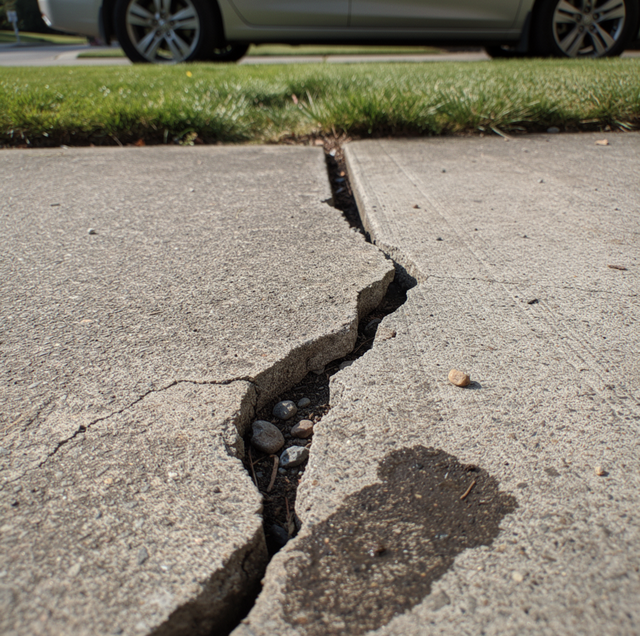
| What You See | What It Usually Means | Repair or Replace |
|---|---|---|
| A single hairline crack, no height difference between sides | Surface shrinkage during curing | Repair (often cosmetic only) |
| A crack you can slide a coin into, with one side higher | Some settling, base may still be sound in that spot | Repair likely, monitor |
| Multiple wide cracks across one large section | Base failure under that section | Replace that section |
| Uniform, gradual sinking across most of the slab | Widespread base or drainage failure | Replace |
| Surface flaking, pitting, or scaling less than an inch deep | Surface-level damage, structure intact | Repair (resurface) |
| Exposed, rusted rebar with spreading cracks around it | Rebar corrosion pushing concrete apart | Replace the affected area |
That table is a starting point, not a final verdict. Every slab is different, and the right call between patching a crack and tearing out a section rests on a handful of specific factors a contractor evaluates on site: how wide the crack is, whether there's a height difference between the two sides, how much of the slab is affected, and whether the base underneath has actually failed or is simply settling in one localized spot.
Why Crack Width Alone Isn't the Whole Story
A hairline crack, often described as narrower than about 1/8 inch, is usually a shrinkage crack that formed as the concrete cured and lost moisture, and it typically doesn't indicate any structural weakness. These cracks can often be left alone or filled with a flexible sealant purely to keep water from working its way in and widening the crack through freeze-thaw cycling over successive winters.
A wider crack, especially one where you can feel or see a height difference between the two sides when you run a hand across it, points to something more significant happening underneath. That height difference, called a trip hazard or a lippage in trade terms, usually means one side of the crack has settled relative to the other, which means the base under one section is no longer supporting the slab evenly. Whether that section can be leveled and saved or needs to come out depends on how much settling has occurred and whether it's still progressing or has stabilized.
Reading a Slab for Extent, Not Just Severity
A single crack, however wide, is a different situation from a slab with a network of interconnected cracks spreading across a large area. One crack often has one identifiable cause: a control joint that wasn't cut in time, a tree root pushing up from below, or a single spot of soft base. A spreading network of cracks across most of a slab section usually signals that the base underneath that whole section has failed broadly, not in one isolated spot, and patching individual cracks in that scenario tends to be a short-term fix, since the underlying support problem keeps generating new cracks in new locations.
Isolated damage: One crack, one clear cause, a base that's likely still sound everywhere else. Repair candidate.
Widespread damage: Multiple cracks, uneven settling across a large section, a base that's failed broadly. Replacement candidate.
What Mudjacking and Polyurethane Foam Lifting Actually Fix
For a slab that has settled but hasn't cracked into a fragmented mess, lifting the existing slab back to level is often a more practical option than replacement. Mudjacking pumps a cement-based slurry underneath the settled slab through small drilled holes, filling the void and raising the slab as the material builds up underneath it. Polyurethane foam lifting works on a similar principle but uses an expanding foam injected through much smaller holes, which cures and expands within minutes rather than the longer set time of a slurry mix.
Both methods can restore a settled slab to level without replacing it, but they only work when the slab itself is structurally sound, meaning it isn't broken into multiple disconnected pieces. A slab that has already cracked through in several places doesn't lift as one unit; it lifts unevenly at each crack, which usually makes the cracking worse rather than better. Lifting methods correct settlement in slabs that are still structurally intact; they don't repair slabs that have already failed structurally.
When Surface Damage Doesn't Mean Structural Damage
Scaling, pitting, and flaking, where the top layer of the concrete surface deteriorates, chips, or flakes away, often looks alarming but frequently affects only the outer skin of the slab, sometimes less than an inch deep, without compromising the structural concrete underneath. This kind of damage commonly results from surface exposure to repeated freeze-thaw cycling combined with moisture that wasn't properly air-entrained into the mix, or from deicing chemicals breaking down the surface paste over successive winters.
A slab with this kind of surface-only damage is frequently a strong candidate for resurfacing: applying a new bonded topping layer over the existing structural slab, rather than removing and replacing the whole thing. Resurfacing only works, though, if the structural concrete beneath the damaged surface layer is sound, which is why a contractor typically sounds the slab (tapping to listen for hollow spots) or checks for delamination before recommending a topping rather than a full replacement.
Rebar Corrosion Changes the Calculation Entirely
When steel reinforcement in a slab or footing begins to rust, the corroding rebar expands because rust occupies significantly more volume than the steel it replaces. That expansion pushes outward against the surrounding concrete from within, producing cracks that radiate from the rebar's location and often exposing rust-stained concrete at the surface. This is a failure mechanism entirely different from shrinkage cracking or base settlement, and it tends to worsen over time rather than stabilize, since the corrosion process continues as long as moisture and oxygen continue to reach the steel.
Sections of concrete showing this pattern, exposed or rust-streaked rebar paired with active, spreading cracks, generally need to be removed and replaced rather than patched, because a surface patch does nothing to stop the corrosion continuing underneath it, and the expanding rust will eventually crack right through any patch material applied over it.
Confirming Base Condition Before Committing to a Repair
A contractor deciding between repair and replacement often wants direct evidence of what's happening underneath the slab rather than relying on surface appearance alone. Core sampling, drilling a small cylindrical plug out of the slab, lets a contractor visually inspect the concrete's thickness, check for voids or moisture at the base interface, and confirm whether the aggregate base below has washed out or compacted unevenly. Probing near an existing crack with a thin rod can also reveal whether there's a hollow gap beneath the slab at that point, a strong sign that the base has eroded away rather than the concrete itself simply cracking.
This kind of direct check matters most on borderline cases, a slab with moderate cracking that could plausibly go either way, where guessing wrong means either paying for an unnecessary full replacement or patching a section that's going to keep failing because the real problem underneath was never addressed.
Weighing Age and Remaining Service Life
An older slab approaching or past its typical service life, and already showing several of the more serious signs above rather than just one, often makes more sense to replace outright than to repair piecemeal. Each individual repair on an aging slab addresses one symptom at a time, and a slab old enough to be failing in multiple spots at once is usually telling you that the whole system- base, drainage, and original mix design together- has reached the end of its useful life rather than suffering from a single fixable defect.
Frequently Asked Questions
Not necessarily on its own. Width matters less than whether there's a height difference between the two sides and whether the crack is actively widening over time versus having stabilized months or years ago. A wide but stable, level crack that hasn't changed in years can be a lower priority than a narrower crack that's visibly growing each season.
Not reliably on your own, but a few clues help: a hollow sound when tapped with a hammer, a section that feels slightly spongy or that rocks underfoot when weight shifts onto it, or water pooling consistently in one spot after every rain rather than draining. A contractor typically confirms base condition by coring a small test section or probing beneath an existing crack rather than relying on surface appearance alone.
It depends on how the patch is done. A crack that's routed first, cut into a shallow V-groove along its length so the sealant has more surface area to grip and room to flex, holds up far better than sealant smeared over the surface of a hairline crack, since a surface-only patch can peel loose from vehicle or foot traffic within a season or two. For a crack that's still actively moving, a flexible polyurethane sealant is the right call because it stretches and compresses with the concrete; a rigid epoxy is reserved for cracks that have stabilized and need to be locked back into one solid piece rather than sealed as a joint. Either way, a patch doesn't address whatever caused the crack in the first place, so if the underlying cause, like ongoing base settlement, is still active, new cracking can appear elsewhere even after a successful patch.
A well-bonded resurfacing layer applied over structurally sound concrete can last many years, often close to what a lower layer of comparable new concrete would achieve, since the bonded topping becomes a functional wearing surface in its own right. Its longevity depends heavily on proper surface prep and bonding before application; a topping applied over dust, oil residue, or a poorly cleaned surface tends to delaminate and fail well ahead of schedule.
Mudjacking uses a heavier cement-based slurry and larger holes, and the added weight of the slurry itself can, in some soft-soil situations, contribute slightly to future settling. Polyurethane foam is far lighter, cures within minutes rather than requiring a longer set time, and the injection holes are small enough to be barely noticeable once patched, though it requires specialized injection equipment that not every concrete contractor carries.
Yes, and this is common when damage is isolated to one section, often between two existing control joints. A contractor saw-cuts along the joint lines, removes just that section, rebuilds the base underneath it if needed, and pours new concrete that ties into the existing slab at the joint. The new section may look slightly different in color and texture until it weathers for a season or two, but it avoids removing sound concrete elsewhere on the slab.
Reading a damaged slab correctly- crack width, height difference, extent of the affected area, and whether rebar corrosion is involved- tells you far more about whether repair or replacement is the right call than age or appearance alone. A contractor who evaluates the base underneath, not just the crack on top, is the one giving you an honest answer either way.
Not sure if your slab needs repair or replacement — Get an honest, on-site evaluation before spending on the wrong fix. PTTC Concrete LLC serves Olympia, Tacoma, and Lacey. Call (253) 785-2490.
