
Concrete vs. Pavers: Which Driveway Wins Long-Term?
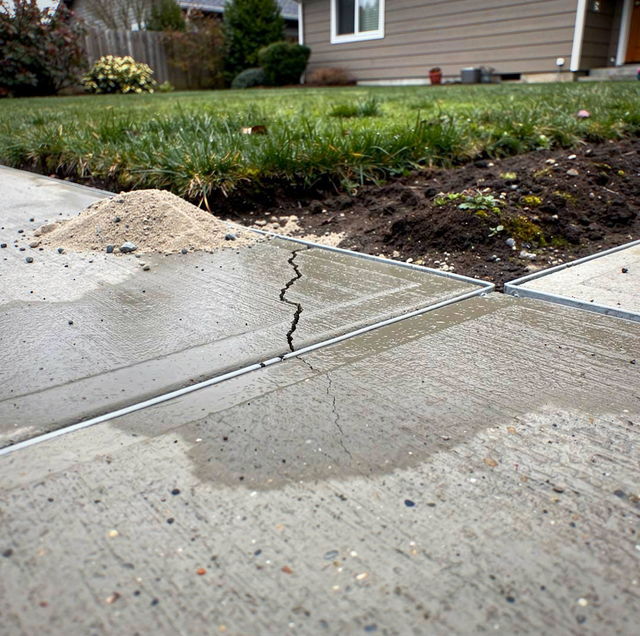
Two driveways can look almost identical the week they're finished and behave completely differently ten years later, and the reason has nothing to do with which one looked better on install day. A poured concrete driveway forms a continuous slab, cured into a single rigid sheet. An interlocking paver driveway is laid as hundreds of individual units, set into sand or stone dust over a compacted base, held together by friction and edge restraints rather than by chemical bonds. That single structural difference, one connected piece versus many independent ones, explains almost everything about how each surface ages, cracks, drains, and gets repaired.
Poured as one piece: Concrete is mixed, placed into forms, and finished while still workable, then left to cure into a monolithic slab. Every part of that slab is physically connected to every other part.
Assembled as many pieces: Pavers are manufactured units, laid by hand or machine onto a bedding layer, with sand swept into the joints between them. Nothing is chemically bonded. The system holds together through compaction and interlock.
How Each Surface Handles Ground Movement
Soil under a driveway never stays perfectly still. It expands when saturated, contracts as it dries, and shifts slightly with seasonal freeze-thaw cycles that pull moisture into tiny cracks and force them wider when that moisture freezes and expands. A rigid, one-piece slab has no give built into it, so when the ground beneath even one section swells, sinks, or heaves, the slab has to absorb that stress somewhere. It shows up as a crack because a solid sheet of concrete can only flex so far before it fractures at its weakest point, often near a control joint, a corner, or wherever the underlying base was thinnest or least compacted.
A paver driveway responds differently. Because the surface is made of separate units resting on a flexible bedding layer, ground movement in one spot allows the pavers directly above it to shift slightly relative to their neighbors rather than forcing a single rigid sheet to crack. The joints between units act as thousands of tiny relief points. That does not mean pavers never move. It means the movement tends to appear as individual units settling out of level rather than as a crack running across the entire surface.
What Happens When Damage Shows Up
This is where the two systems diverge the most in daily practice. When a concrete slab develops a crack, a stain, or a section that settles unevenly, the repair options are limited because the surface is a single continuous piece. A contractor can saw-cut and patch a damaged section, but a patch rarely matches the surrounding concrete in color or texture exactly, especially once the original slab has weathered and lightened over a few seasons. Full replacement of a driveway means demolishing and hauling out the old slab, a disruptive job that closes off the driveway for days.
Pavers offer a different repair path. If one or more units crack, stain, or sink, a contractor can lift just those units, correct the base or bedding sand beneath them, and reset them, or swap in fresh units from the same product line. Because the surface was designed as individual pieces from the start, spot repair does not require touching anything beyond the affected area, and matching pavers pulled from a stored spare batch or the same manufacturer run blend in far better than a concrete patch ever can.
| Factor | Poured Concrete | Interlocking Pavers |
|---|---|---|
| Installation method | Single continuous slab poured in forms | Individual units set on compacted base and bedding sand |
| Ground movement | Absorbs stress as cracking, since the surface is rigid | Flexes at the joints; individual units can shift or settle |
| Repair approach | Saw-cut patch or full slab replacement | Lift and reset or swap individual units |
| Drainage | Sloped surface sheds water; sealed surface resists penetration | Permeable joint sand allows some water through the surface itself |
| Surface texture options | Broom finish, stamped, exposed aggregate, or smooth | Wide range of shapes, colors, and laid patterns |
| Long-term appearance | Uniform slab that ages and weathers as one piece | Individual units age independently; spares match better |
The Base Underneath Matters More Than the Surface Material
Whichever surface you choose, the single biggest factor in how long a driveway lasts is what happens before either concrete or pavers ever go down. Both systems depend on a properly excavated and compacted base of crushed rock, typically several inches deep, compacted in lifts rather than dumped and leveled in a single pass. Skimp on excavation depth or skip proper compaction, and even the best concrete mix or the highest-grade pavers will settle unevenly within a few years. A driveway built on a well-prepared base will outperform a driveway built with premium material on a rushed base every time.
Compaction quality: A base compacted in lifts with a plate compactor holds its shape under vehicle weight far better than loose fill graded once and left.
Drainage slope: Both concrete and paver driveways need a slight slope, often around a quarter inch per foot, so surface water runs off instead of pooling and working its way into joints or hairline cracks.
Drainage and Water Behavior
Water behaves differently on each surface, and that difference matters more than it looks at first glance. A concrete driveway, once sealed, sheds nearly all surface water off to the sides or toward a drain, since the slab itself is essentially impermeable. That works well as long as the slope is correct and the sealer is maintained, but if water finds its way to an edge, a crack, or an unsealed joint, it has nowhere to go but down into the base, where repeated freeze-thaw cycling can undermine support from below.
A paver driveway, particularly one installed with permeable jointing sand or open-graded bedding stone, allows some water to pass directly through the surface into the base layer, where it can drain laterally rather than pool on the surface. That reduces surface ponding in a heavy downpour, but it puts more importance on the base and drainage layer underneath doing its job, since more water is reaching it directly rather than being shed to the sides.
Weighing the Decision for Your Driveway
The right choice depends less on which material is objectively better and more on what you actually want out of the driveway over the next couple of decades. If a uniform, unbroken surface with decorative options like stamped patterns or exposed aggregate matters most to you, and you are comfortable with saw-cut patch repairs if cracking ever occurs, poured concrete delivers that clean, single-surface look. If you would rather have a system where an individual damaged section can be lifted, fixed, and reset without leaving a visible patch, and you like a broader range of shapes and laid patterns, pavers offer that flexibility, though even well-matched replacement units are never perfectly identical to originals that have already weathered for a few seasons.
Edge Restraints and Expansion Joints Do Different Jobs
A paver driveway depends on edge restraints, rigid strips of plastic, aluminum, or concrete set along the perimeter and anchored into the base, to keep the outermost units from creeping outward under repeated vehicle load. Without a solid edge restraint, a paver field slowly spreads at the margins over time, opening gaps and loosening the interlock that holds the whole surface together, even if the field itself was installed correctly.
A concrete driveway uses a different device for a similar purpose: expansion joints, strips of compressible material placed wherever the slab meets a fixed structure like a garage foundation, a sidewalk, or a stamped apron. Concrete expands and contracts slightly with temperature changes, and an expansion joint gives it room to do so without pushing against an immovable structure and cracking at the joint. Skipping expansion joints where a driveway meets a garage slab is a common reason for cracking to concentrate right at that seam.
Either way, the decision is really about how you want to handle the driveway's inevitable interaction with moving ground and seasonal moisture, not just which surface looks best in a showroom photo.
Frequently Asked Questions
Not directly in most cases. Pavers need a properly compacted aggregate base and bedding layer to perform correctly, and setting them directly on old concrete skips that base entirely, so movement and drainage problems tend to follow quickly. The existing slab usually needs to be removed, or in some situations it can serve as a stable sub-base if it is broken up (a process called rubblizing) to allow proper drainage and settling beneath the new paver system.
Control joints are cut or formed into the slab to create a deliberately weaker line where the concrete is more likely to crack in a straight, hidden seam rather than randomly across the visible surface. They do not prevent shrinkage cracking; they direct where it occurs. Spacing control joints roughly 24 to 30 times the slab's thickness apart is a common guideline contractors use to keep random cracking to a minimum.
Base depth depends on soil type and expected vehicle loads, but a typical residential driveway calls for several inches of compacted crushed rock beneath the slab or pavers, with deeper base sections in areas of soft or clay-heavy native soil. Heavier vehicles, like an RV or a boat trailer, generally call for a thicker base and sometimes a thicker slab than a driveway built only for passenger cars.
Often yes. Because pavers are a manufactured, sealed unit, many stains from oil, rust, or tannins can be treated with a degreaser or a paver-specific cleaner and then resealed, restoring much of the surface's original appearance without lifting or replacing anything. Deep, set-in stains or units that have physically degraded from prolonged exposure are the cases where swapping the unit makes more sense than continued cleaning.
Yes. A large root growing under a rigid concrete slab has to lift or crack the entire slab section above it, since the slab cannot flex around the root. Under a paver driveway, a growing root often lifts only the units directly above it, leaving neighboring units level, making the resulting bump easier to correct by lifting and resetting only the affected pavers after addressing the root.
Joint sand can gradually wash out due to heavy rain, pressure washing, or repeated vehicle traffic, and thinning joints reduces the interlock that keeps the units stable. Checking joints once a year and topping off with polymeric sand, which hardens slightly after application to resist washout better than plain sand, keeps the interlock system working as designed.
Whichever surface you choose, ask any contractor bidding the job how deep they're excavating and how they're compacting the base before you spend much time comparing finish options, because that answer predicts the driveway's future far more reliably than a sample board of stamped patterns or paver colors ever will. A rigid slab and a flexible paver system fail for different reasons and are repaired in different ways, but neither outruns a base that was never built to support it.
Weighing concrete or pavers for your next driveway — Get an on-site evaluation of your soil, slope, and drainage before you decide. PTTC Concrete LLC serves Olympia, Tacoma, and Lacey. Call (253) 785-2490.
