
Stamped Concrete Patterns: Choosing a Finish That Lasts
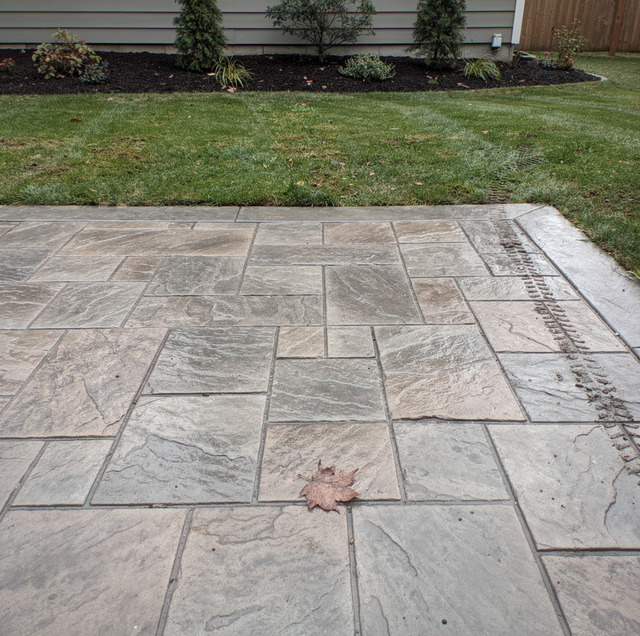
Choosing a stamped concrete pattern isn't really one decision. It's a sequence of choices made in order, several of them before the concrete even gets poured, and skipping or rushing any step in that sequence is why some stamped patios and driveways still look sharp after a decade while others look faded and worn within a few years.
Step One: Pick the Pattern Before the Pour, Not After
Stamped concrete gets its texture from rigid or flexible mats pressed into the surface while the concrete is still plastic, meaning workable but no longer wet enough to flow. Common pattern families include ashlar slate (irregular, flat-cut stone shapes), running-bond or herringbone brick, cobblestone, and wood plank, each using a different mat set to press a repeating or randomized texture across the surface. The pattern choice has to happen well before the pour, because it determines how the slab gets laid out relative to any control joints, and joints ideally get placed along the natural lines of the pattern, like the mortar lines in a brick layout, so they blend in rather than cutting awkwardly across a stone or plank shape.
Ashlar slate: Irregular flagstone-style shapes, forgiving of joint placement since the pattern has no fixed repeat.
Brick and cobblestone: Repeating units where joint placement needs more planning to land naturally within the pattern's grid.
Step Two: Decide How Color Gets Into the Concrete
Color in stamped concrete comes from one or more of a few distinct methods, each producing a different look and holding up differently over time. Integral color is mixed directly into the concrete before it's poured, coloring the entire depth of the slab uniformly, which means a chip or wear spot reveals the same color underneath rather than a different-colored substrate. Color hardener is broadcast onto the surface just before stamping and worked into the top layer, producing a denser, harder surface than integral color alone and allowing more vivid color options, though it only colors the top portion of the slab. A release agent, either a powder or a liquid, prevents the stamping mats from sticking to the wet concrete, and powder release agents in particular leave behind a secondary antiquing color in the low points of the texture, creating the two-tone, weathered-stone look many stamped patios aim for.
Step Three: Time the Stamping Correctly
Concrete has a narrow working window for stamping, after it's been finished (floated and troweled) but before it sets up too firm to take an impression. Stamp too early, while the concrete is still too soft, and the mats sink too deep or the surface slumps around the edges of the texture. Stamp too late, after the surface has begun to firm up, and the pattern doesn't imprint with enough depth or definition, leaving a shallow, faded-looking texture that never really improves no matter how it's finished afterward. Getting this timing right depends heavily on temperature, humidity, and the specific concrete mix, which is why experienced crews watch the slab's surface condition directly rather than working off a fixed clock.
| Method | What It Colors | Typical Look |
|---|---|---|
| Integral color | Full depth of the slab | Uniform color throughout, even if chipped |
| Color hardener | Top surface layer | Denser surface, more vivid color range |
| Powder release agent | Texture low points only | Two-tone antiqued, weathered-stone effect |
| Liquid release agent | Surface film, minimal secondary color | Cleaner separation between mats, less antiquing |
Step Four: Seal It, and Then Reseal It on Schedule
A stamped surface is only as durable as its sealer, because the sealer is what protects both the color and the texture from UV exposure, foot and vehicle traffic, and moisture intrusion into the textured low points where water naturally collects. Two sealer families dominate: film-forming acrylic sealers, which sit on top of the surface and enhance color and sheen, and penetrating sealers like silane or siloxane formulations, which soak into the concrete rather than forming a surface film and don't change the surface appearance much but block water absorption effectively.
Film-forming acrylic sealers wear with foot traffic and UV exposure over time and need to be reapplied on a recurring schedule, often every couple of years depending on exposure and traffic, to prevent fading and maintain the surface's sheen and water resistance. Skipping resealing is one of the most common reasons a stamped patio that looked vibrant when new becomes chalky, faded, and dull within just a few seasons, since the sealer protecting both the color and the surface has simply worn away.
Why Faded Stamped Concrete Usually Isn't a Color Problem
When a stamped surface looks faded, the actual color pigment in the concrete, whether integral or hardener-based, is often still largely intact beneath the surface. What's usually gone is the sealer that gave the color its depth and sheen, along with a thin layer of surface wear that's dulled the texture's fine details. That distinction matters because it means a faded stamped surface can often be restored by cleaning and resealing rather than needing to be replaced or recolored from scratch, provided the underlying concrete hasn't suffered structural damage such as spalling or cracking.
Matching a Pattern to How the Space Gets Used
Beyond appearance, pattern and finish choices should account for how a surface will actually be used. A stamped texture with deep grout lines and pronounced relief, common in cobblestone or heavy ashlar patterns, can hold more water in those low points and become slicker when wet than a shallower, more subtle texture, which matters more around a pool deck or an entry that regularly gets walked on with wet feet. A lighter, more textured broom-style finish, or a shallower stamp pattern paired with a slip-resistant additive in the sealer, often makes more sense in high-traffic, frequently wet areas than the deepest, most dramatic texture available.
Frequently Asked Questions
No, not with true stamped texture. Stamping requires pressing mats into concrete while it's still plastic during the original pour, so an already-cured slab can't be textured this way. An overlay system, a thin layer of specialized concrete or cement-based product applied over the existing slab and then stamped while that overlay is still workable, can achieve a similar look on an existing surface, though overlays have their own bonding and thickness requirements separate from a full stamped pour.
Yes, in a few respects. Stamped concrete generally benefits from a slightly lower slump (a stiffer mix with less water) than a plain broom-finished slab, since a wetter mix is harder to stamp cleanly and more prone to the mats sinking too deep or slumping at the pattern edges. Air-entrainment, tiny air bubbles intentionally mixed into the concrete that give trapped water room to expand during freezing, matters just as much for stamped concrete as for any exterior slab exposed to freeze-thaw cycling.
Rather than cutting straight joint lines across the surface after the pour, as is typical on a plain slab, most control joints in stamped concrete get tooled in during the stamping process itself, using a hand groover run along the pattern's existing grout lines while the concrete is still workable, so the joint disappears into the design instead of showing up as a fresh cut. When a joint still has to be saw-cut later, usually where the layout couldn't fully absorb the required spacing, the cut gets run along the nearest grout line and then colored to match with a joint-tint product, since an uncolored saw cut stands out as a bright gray line against a textured, colored surface in a way it never would on plain broom-finished concrete.
It can leave more visible residue on surrounding surfaces during application, since the powder is broadcast over the whole area before stamping, but it produces the antiquing effect many homeowners specifically want and is generally washed off the finished surface as part of the curing and cleanup process. A liquid release agent is typically cleaner to apply and leaves less residue on adjacent landscaping or hardscape, but it also produces less of that secondary antiqued color variation in the low points of the texture.
Small chips can sometimes be patched and blended with color-matched repair compounds designed for stamped surfaces, though achieving a close color and texture match depends heavily on how closely the technician can match the texture and color to the surrounding original work. A crack running through a stamped section is harder to disguise than on a plain slab, since the crack often follows or crosses the texture pattern unpredictably, which is part of why proper joint planning at the pattern-design stage matters so much for controlling where cracking is likely to occur.
It depends heavily on exposure and traffic rather than a single universal number: a shaded, low-traffic patio may hold its sealer noticeably longer than a driveway exposed to full sun, vehicle traffic, and deicing exposure in winter. A simple field test, splashing water on the surface and watching whether it beads up or soaks in, tells you in seconds whether the existing sealer is still doing its job or whether it's time to clean and reapply.
Stamped concrete rewards planning done before the pour and maintenance done on a schedule after it. Pattern and joint layout, color method, stamping timing, and reapplying the sealer on schedule all work together, and skipping any one of them is usually why a stamped surface looks tired years before it should.
Considering stamped or decorative concrete for your next project — Get pattern and finish options matched to how you'll actually use the space. PTTC Concrete LLC serves Olympia, Tacoma, and Lacey. Call (253) 785-2490.
