
Why Tree Roots Crack Concrete: Two Opposite Reasons
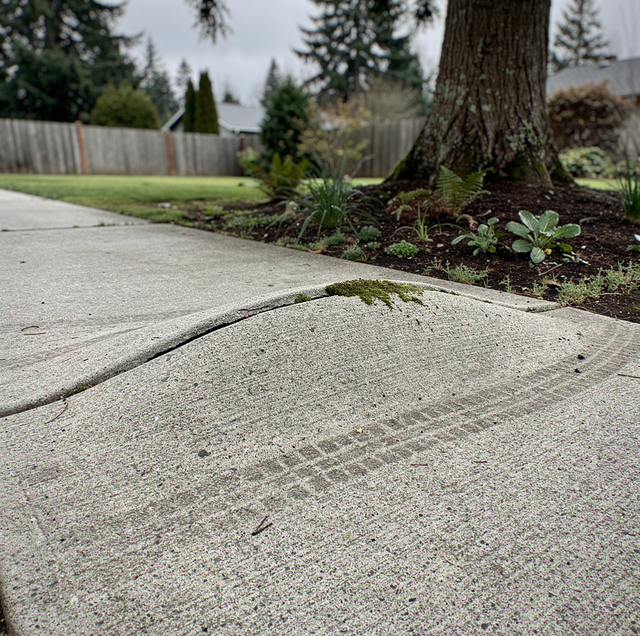
A driveway near a mature maple humps up in the middle, a crack running straight across the highest point. A few properties over, at a house with a different tree, a walkway has done the opposite: one six-foot panel has dropped noticeably below the section next to it, and the crack that formed sits along the low edge, not the high one. Both driveways are being damaged by tree roots. Neither problem looks anything like the other, and neither one gets fixed by the same method.
Two Mechanisms, Two Different Crack Patterns
A root damages concrete two different ways. One is pressure: the root thickens under the slab until the concrete has to bend around it. The other is closer to the opposite, taking support away rather than adding force, by pulling moisture out of the ground the slab rests on. Which of the two shows up on a given driveway has less to do with the tree than with what sits under the concrete. Telling the two apart matters because the repair for one does nothing for the other, and a contractor who treats a sinking section like a lifting one is fixing the wrong problem.
A raised, tented section with a crack running across its high point is a lift. A growing root physically pushed the slab upward from below, and the crack is the concrete failing under that pressure at the point of greatest bend. A settled, dished section with a crack that opens at the low point, often with a hollow sound underfoot when you walk or drive over it, is subsidence. The slab didn't get pushed anywhere. The ground beneath it shrank, and the panel dropped into the opening. Same tree, same driveway even, and these two outcomes can show up a few feet apart from each other for two entirely different reasons.
Lift: The Pressure of a Root Growing Under a Slab
A tree root doesn't just get longer as the tree ages. Once it's established, it starts adding girth the same way the trunk does, laying down a new ring of wood outward each growing season. That process, called secondary growth in the same botanical sense as a trunk's annual rings, is what turns a root that once slipped under a slab edge unnoticed into one thick enough to matter.
A residential driveway or walkway is typically plain concrete, with at most light wire mesh for shrinkage control. It has almost no reinforcement to resist an upward force from below, and the compacted gravel base beneath it is far weaker than the slab itself. When a thickening root runs directly under that base, it displaces the material in its path, and the base has nowhere to direct that pressure except upward through the slab. Because a root is thickest closest to the trunk and tapers as it extends outward, the section sitting over the widest part of the root rises the most, and concrete resists compression far better than it resists bending. The panel cracks at the high point, roughly across the root's path, because that's where it's being flexed hardest.
Subsidence: How Roots Pull Moisture Out From Under a Slab
A mature tree moves a large volume of water out of the soil through its root system every day it's actively growing. During an extended dry stretch, when rainfall isn't replacing what the tree is pulling, that draw comes straight out of the ground the slab is sitting on.
In fine-grained, clay-heavy soil, that matters because clay particles swell when wet and shrink when they dry, changing the soil's actual volume. A root system withdrawing moisture from under a slab during a dry period shrinks that clay, and shrinking soil takes up less space than it did. The slab was never designed to span a gap; it was resting on continuous support. Once that support contracts unevenly, wherever moisture loss and shrinkage are worst, the panel drops into the space that opens beneath it. The result is a dished, uneven settlement rather than a straight-line sag, and the crack opens along the low edge, where the unsupported concrete is flexing downward instead of being held up. The soil movement itself is seasonal, and clay that shrank through a dry summer swells again once the rain returns, but the concrete does not come back with it: a panel that has already cracked and dropped out of plane stays cracked and out of plane through every wet season after.
A dished section that sounds hollow is a full-thickness slab spanning empty ground where the soil shrank away beneath it. Concrete in bending over an unsupported gap can crack further or drop under a vehicle.
Why Clay Soils Make the Subsidence Pattern Worse
Not every soil responds to a dry root system the same way. Clay-heavy soil has a high shrink-swell range: it can lose a meaningful percentage of its volume as it dries out, which is exactly the mechanism subsidence depends on. Sandy or gravelly soil barely changes volume with moisture content at all, so the same tree, pulling the same amount of water, produces a fraction of the settlement over a sandy subgrade that it would over clay.
Poorly prepared subgrade compounds the effect. A slab poured over loose fill or leftover topsoil instead of properly compacted base material already has more air space to lose, and a root system drying that material out finds less resistance and more room to shrink than it would under a base that was compacted correctly in the first place. Two identical trees next to two identical slabs can produce a barely visible dip in one yard, and a half-inch drop in the other, and the difference is almost always what's under the concrete, not what's growing next to it.
Why the Damage Waits Years to Show Up
A newly planted tree has a small root system made up mostly of fine, absorptive roots built to establish the tree, not to move much water or grow thick woody laterals yet. Its water demand is modest, and it isn't producing the kind of structural root that generates lift. That's why a slab poured when a tree was young typically shows no problems for the first several seasons.
It takes years, and depending on the species, it can take a decade or more, for a structural root to reach the diameter that causes lift, or for the tree's water demand to rival what a dry season's rainfall shortfall can do to the soil beneath a slab. Nothing about the concrete changed in that time. The tree simply grew into a relationship with the slab that didn't exist when both were new, which is why this kind of damage so often gets blamed on the concrete's age instead of the tree's growth.
Where Repair Ends, and the Tree May Have to Go
A small lip from a minor lift can often be ground down flush, restoring a level surface without touching the slab's structure. That is a holding action rather than a repair, though, because the root underneath keeps thickening after the grind: what a grind buys is time before the same lip comes back.
Grinding takes material off the top of the slab, so what limits it is the thickness and the drainage slope left afterward, not a fixed figure. Have both measured on the slab before choosing a grind over cutting the section out.
Beyond a lip that grinding can take out, or with a dished, unsupported subsidence panel, the more durable fix is to cut the affected section free at its control joints and repour it, sometimes paired with correcting whatever caused the soil to shrink or the root to grow where it did. A root barrier, a rigid panel installed in a trench beside the slab to deflect root growth downward or sideways, only works as prevention. It does nothing to a root that has already reached the area, because the barrier can't remove a root that's already there; it can only stop the next one from arriving. That gives it a real window to help and a real point past which it can't.
Sometimes the honest assessment is that the slab and the tree can't both stay as they are: a structural root large enough to be causing significant lift often can't be cut without threatening the tree's stability, and a root plate that close to the slab may not leave room for a barrier to do anything useful. If the tree in question is planted in the strip between the sidewalk and the street, it's frequently not the homeowner's tree to remove at all. Any significant root work or removal on a tree like that, and often on any mature tree, should go through the local authority that governs it rather than being decided on the driveway.
A read on the crack pattern, the tree's proximity, and what's actually under the slab is what determines whether the fix is a grind, a section replacement, or a harder conversation about the tree, and guessing based on how bad the crack looks from the porch is how homeowners end up paying for the wrong one.
Frequently Asked Questions
Yes. A tree's fine, absorptive roots, the ones actually pulling moisture from the soil, extend well beyond its visible structural roots and often reach two to three times the width of the canopy above. A tree can be drawing water directly from under a slab, with no roots anywhere near that spot, producing subsidence with no lift at all.
Fast-growing, shallow-rooted species, including silver maple, willow, and some poplar and ash varieties, develop the thick lateral roots responsible for lift years sooner than a deep-rooted species like an oak. Their root systems remain concentrated in the top foot or two of soil, which is exactly where a slab's base sits.
Sometimes, but not always safely. Arborists generally won't cut more than about a quarter of a tree's root mass at once, and only on one side, because removing more than that risks compromising the tree's anchorage in the ground, a genuine hazard on a mature tree standing that close to a driveway.
No, and where it goes decides whether it ever helps. A barrier has to extend below the shallow lateral roots it is deflecting, which usually means a trench about two to three feet deep. It belongs in the soil between the tree and the slab edge rather than tight against the concrete, so an approaching root meets the panel and turns down well before it reaches the slab's base.
Often, yes, for another season or two. The tree's cut roots die and decay in place underground, and that decay leaves small voids that the surrounding soil keeps settling into even after the moisture draw that started the problem has stopped.
Yes, and the crack worth watching is the one between them. Where a lifted panel meets a settled one, the concrete bridging the two is being pushed up at one end and dropped at the other, and a plain slab has almost no capacity to take that twist. The break shows up at or near the joint between the panels, usually with a vertical lip you can feel underfoot where one side stands proud of the other.
Get a professional read on your slab — we can tell you whether root damage calls for grinding, a section replacement, or a barrier, and help you sort out whether the tree needs to be part of that decision. PTTC Concrete LLC serves Olympia, Tacoma, and Lacey. Call (253) 785-2490.
