
Why Does New Concrete Develop Hairline Cracks?
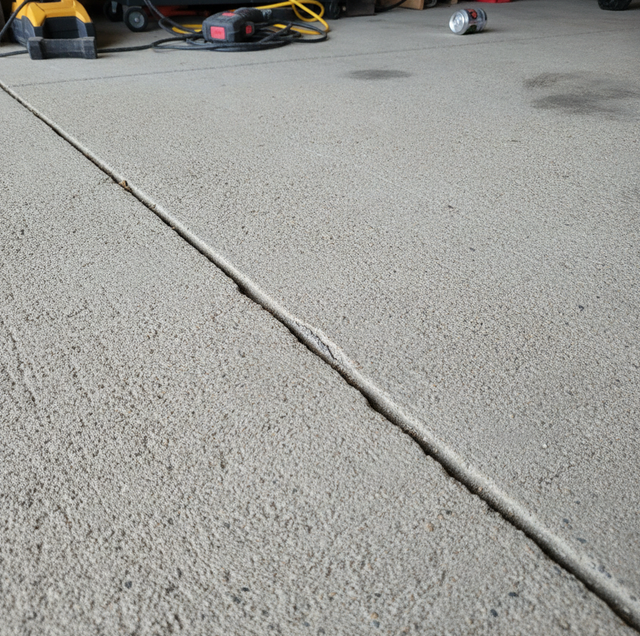
The slab is barely a few weeks old, and thin lines are already tracing across the surface. It stings to spot cracks in something you just paid to have poured, and the reflex is to assume the pour was botched. In most cases, though, hairline cracks in new concrete are a normal part of how the material cures, not a defect. Knowing why they form, and which ones deserve attention, takes the alarm out of a small crack and tells you when one is worth a closer look.
Why Fresh Concrete Cracks at All
Concrete shrinks as it dries. Fresh concrete is loaded with water, and as that water leaves during curing, the slab pulls in on itself and gets slightly smaller. But the slab is not free to move, friction against the ground below and its own weight hold it in place. So as it tries to shrink, tension builds, and concrete is strong under compression but weak under tension. When that tension outruns its small ability to stretch, it relieves itself the only way it can: by cracking.
This is the material behaving as concrete behaves, not failing. Nearly every common crack in a new slab traces back to shrinkage, in two forms that depend on when the moisture leaves.
Plastic Shrinkage Versus Drying Shrinkage
The earliest cracks are plastic shrinkage cracks. They appear while the concrete is still soft (often within hours of the pour) when the surface loses moisture faster than the interior can supply it. Wind, heat, direct sun, and low humidity all speed up that surface evaporation, which is why a slab poured on a dry, breezy day is more prone to these short, scattered lines than one poured in still, damp conditions.
Drying shrinkage cracks come later and slower. As the whole slab gives up moisture over the following weeks, the entire mass shrinks, and the fine lines that emerge are drying shrinkage. Where plastic shrinkage is the surface racing ahead of the interior in the first hours, drying shrinkage is the full slab contracting as it cures out. Both kinds are usually hairline, both are widespread in new slabs, and neither, on its own, points to a structural problem.
Why the Grooves Are There on Purpose
Since the slab is going to shrink and crack no matter what, good concrete work does not fight that; it decides where the crack lands. Those straight grooves cut or tooled into a driveway or patio are control joints, sometimes called contraction joints. Each is a deliberately weakened line, thinner than the surrounding slab, so that when shrinkage tension builds, the crack forms down inside the joint rather than wandering across the open surface. A hairline crack sitting in a control joint is the joint doing precisely what it was built to do.
Spacing matters. Joints go in at planned intervals scaled to the slab's thickness and layout, tightening up on thinner pours and around inside corners where tension concentrates. The exact spacing is a judgment the finisher makes for the slab, not a fixed number, and joints are cut early, before the slab has hardened enough to crack on its own. Expansion joints do a related but different job: giving the slab room to push against a wall, foundation, or neighboring pour without binding.
How Curing Changes the Outcome
Because the cracking is driven by moisture leaving too fast, how the fresh slab is cured shapes how much of it you see. Curing means keeping the concrete moist and its temperature steady for the first several days so the water leaves gradually instead of flashing off the top. Wet burlap, plastic sheeting, or a sprayed curing compound all slow that early evaporation and give the concrete time to gain strength before it is asked to resist much tension. A slab left to dry out fast in wind and sun on its first day is far more likely to show plastic shrinkage lines and surface crazing than one kept damp. Curing does not erase shrinkage, but it steers more movement into the joints and away from the open surface.
The Base Under the Slab
A slab is only as stable as what it sits on. Beneath good concrete is a compacted base (usually crushed rock graded and tamped level) that spreads the load evenly and holds the slab at a constant height. When that base is poorly compacted, uneven, or built on soft ground, the slab can settle later, and the cracks that follow are movement cracks, a different animal from curing shrinkage. Local ground matters here: wet, fine soils swell when saturated and shrink back as they dry, lifting and dropping a slab from below. In damp climates, the ground stays wet much of the year and dries out in the warm stretch, so the base sees both states, and a slab on a weak or waterlogged base develops widening, uneven cracks that curing alone would never produce.
Telling a Cosmetic Crack From a Real Concern
Most hairline cracks are cosmetic, especially the thin ones and those living in control joints. A crack earns a closer look when it is wide rather than hairline, when one side sits higher than the other so the surfaces no longer line up, when it keeps growing week over week, or when it runs out from an inside corner. Any of those can signal base or soil movement rather than simple shrinkage.
Crazing and structural cracks are two lookalikes worth separating. Crazing is a fine web of shallow, interconnected lines across the surface (like the cracks in old pottery glaze), confined to the top skin of the slab. A structural crack goes deeper, runs in a single line rather than a web, and often comes with width or displacement.
Putting It All Together
Hairline cracks in new concrete are, in most cases, the material doing what it naturally does: shrinking as it cures and relieving that tension by cracking, ideally down inside the control joints built to catch it. The cracks to watch are the wide, uneven, growing, or corner-sprung ones, particularly where wet ground may be shifting the base below. Reading that difference turns a worrying line into a non-issue, or flags the rare one that is not.
Frequently Asked Questions
It does, and it is one of the more common causes people never see coming. A "wet" or soupy pour that is easier to spread and finish carries more water than the cement needs, and every bit of that extra water eventually has to leave the slab. More water out means more shrinkage, which means wider and more frequent shrinkage cracks. A batch that arrives already stiff and workable, rather than watered down on site to make it flow, gives up less volume as it cures and pulls apart less. So if a finisher is careful about not over-wetting the mix, that choice is quietly working in your favor long before you ever spot a line.
Timing is as important as spacing. Joints are cut early, tooled into the surface while the concrete is still plastic, or saw-cut within roughly the first day once it has set enough to hold a clean edge but before shrinkage tension has built. Cut too late, the slab has already relieved itself with a random crack of its own choosing, and the joint you add afterward is just decoration. The same failure shows up when joints are spaced too far apart: the concrete cracks in the open field between them because there was no nearby weak line to catch the tension. A crack running near a joint but not in it often points to one of these two timing or spacing misses.
Sealing a stable hairline crack is worth doing, mainly to keep water out rather than to add strength. A flexible, paintable concrete crack sealant fills the line and flexes as the slab moves slightly with temperature, so the seal does not pop in the first cold snap. For the surface as a whole, a penetrating sealer soaks in and repels water without leaving a film. Keeping water out matters most before a wet, freezing stretch, water that seeps into a crack and then freezes expands and pries the line wider over repeated cycles, and in warmer months, that same trapped moisture feeds staining and surface wear. Sealing a cosmetic line early spares you a bigger opening later, in any season.
A few quick checks separate the two without any tools you do not already own. Run your fingernail across the line: if it barely catches, the crack is hairline and almost surely cosmetic. For a rough width gauge, try slipping the edge of a nickel or a credit card in; a line too tight to admit either is the harmless kind, while one that swallows a coin's thickness deserves attention. Then feel across the crack for vertical displacement: if one side sits higher than the other, so you can feel a lip, that points to movement below, not curing. Finally, mark the ends with a pencil and check back over a few months; a crack that visibly widens or lengthens is active, and active cracks are the ones to have looked at.
Not exactly, and it helps to know what each does and does not do. Rebar and welded wire mesh do little to prevent hairline shrinkage cracks; their job is to hold the two sides of a crack together once it forms, keeping the pieces aligned and load-sharing so a fine line never opens into a gap or steps out of level. Fiber reinforcement mixed through the concrete works earlier, helping curb the very fine plastic shrinkage cracking in the first hours by knitting the soft mix together as it sets. What none of them can do is override a bad base or an over-wet mix; reinforcement manages cracking, it does not cancel the forces that cause it.
The stakes rise with what the concrete is holding up. A hairline crack in a driveway, patio, or sidewalk slab is usually cosmetic; these flat, ground-supported surfaces are expected to show curing lines, and a thin one is rarely a serious issue. A crack in a foundation wall or footing carries more weight, since that concrete is bearing the structure above, so displacement, active widening, or water pushing through there warrants a prompter look than the same line in a patio would. Wet ground plays into both: soils that swell when saturated and shrink as they dry work on a foundation year-round, so a foundation crack that keeps changing is worth watching more closely than a stable hairline in a slab.
If a crack in your slab looks like more than normal curing, we can evaluate it and recommend the right fix. PTTC Concrete LLC serves Olympia, Tacoma, and Lacey. Call (253) 785-2490.
